
Healthcare cyber risk is no longer just about servers and devices. It is now about systems that can watch, decide, and act on their own.
If I boil this article down to the part that matters most, it’s this: autonomous healthcare tools can turn a small security issue into patient harm, PHI exposure, or care delays fast. That risk shows up in four places at once: AI models, connected devices, machine identities, and third-party vendors. And the fix is not one tool. It’s a set of clear steps: inventory what can act on its own, limit access, segment systems, keep human approval for high-risk actions, and watch model, device, and workflow behavior all the time.
A few facts make the point fast:
- 100 to 500 poisoned samples may be enough to alter model behavior while test scores still look normal
- A ransomware study found hospital mortality rose by 33%, from about 3 in 100 patients to 4 in 100
- In healthcare, a bad input may not stop at bad data - it can become a wrong order, missed alarm, overdose, or delayed treatment
- Service accounts, API keys, and device credentials can let attackers move through systems without posing as a doctor or nurse
Here’s the article in plain English:
- AI tools add new weak points: poisoned training data, prompt injection, PHI leakage, and silent model drift
- Connected devices add physical risk: pumps, robots, monitors, and gateways can turn false signals into action
- Closed-loop systems make harm move fast: one bad input can pass from sensor to model to device with little review
- Vendors add supply-chain risk: model updates, subprocessors, cloud control paths, and weak audit detail can leave hospitals blind
- Machine identities matter: non-human accounts often have broad permissions and poor logging
- The main controls are simple to state: know what you have, contain it, review changes, require human override, and monitor behavior across the full chain
- Procurement is part of security: ask for SBOMs, patch plans, update rules, audit trails, and BAA terms before go-live
| Risk area | What can go wrong | What to do now |
|---|---|---|
| AI models | Poisoned data, prompt injection, PHI leaks | Track model use, test changes, watch outputs |
| Connected devices | Tampered firmware, spoofed signals, false telemetry | Segment networks, limit interfaces, keep local stop controls |
| Machine identities | Abused service accounts, hidden access, silent data movement | Use least privilege, rotate keys, log machine activity |
| Vendors and supply chain | Hidden model changes, weak subprocessors, poor visibility | Review contracts, require evidence, reassess high-risk vendors |
If I had to put the whole piece into one line, it would be this: when healthcare systems can make or trigger decisions on their own, security has to cover the full path from data to action.
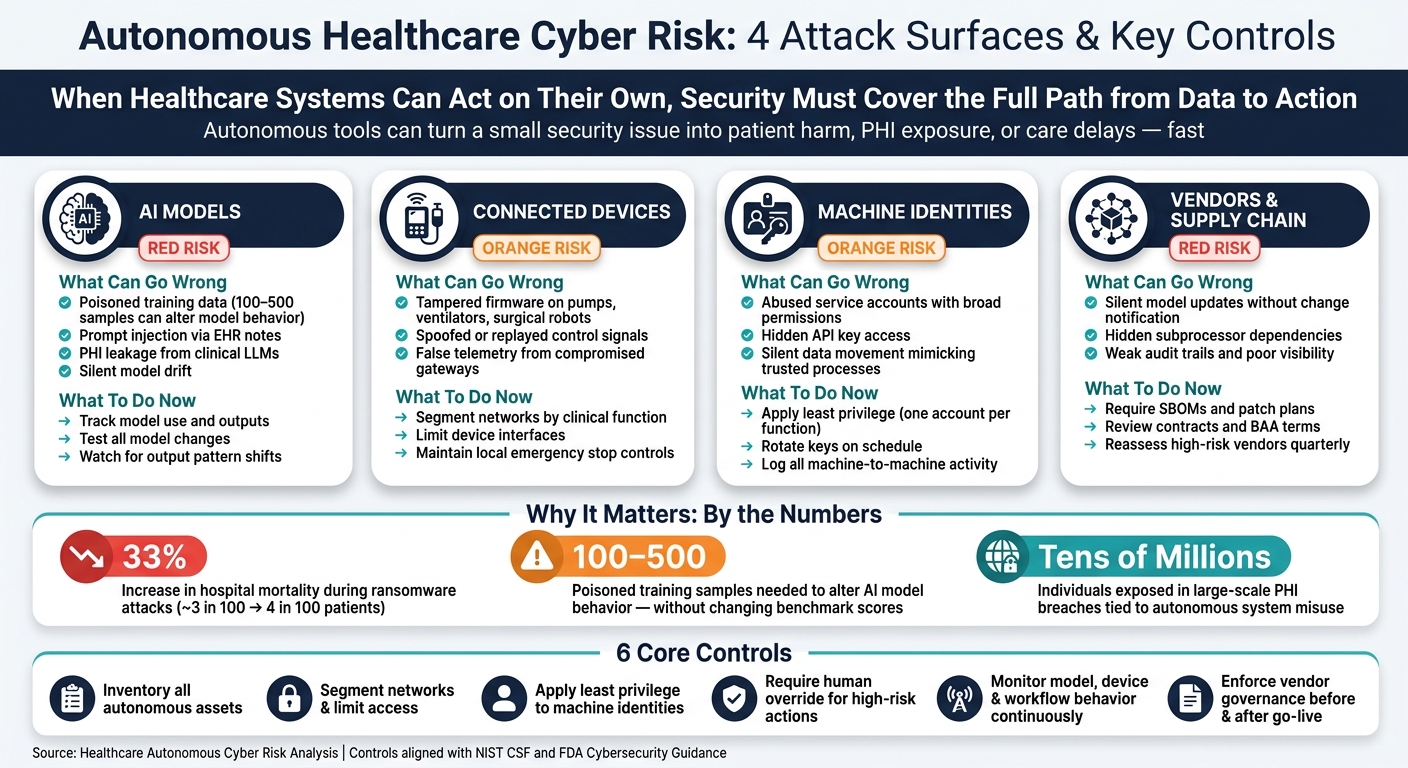
Autonomous Healthcare Cyber Risk: 4 Attack Surfaces & Key Controls
Where autonomous systems create new exposure points
AI models and automated clinical workflows
Risk often starts in the data pipeline. When training systems pull from live clinical data like PACS images and EHR notes, that upstream data can be tampered with. Research shows that just 100–500 poisoned samples can plant hidden behavior inside a diagnostic or documentation model without changing benchmark scores, which makes the attack tough to spot.[8][12]
One radiology case shows how this can play out in practice. An attacker with access to a hospital's PACS slipped crafted samples into routine data collection used for continuous retraining. The result: a pneumonia-detection model produced false negatives for certain patient groups while still seeming normal on aggregate metrics.[5][8] That's the danger here. The clinical decision is automated, the failure is quiet, and no person checks the output at the moment the model makes the call.
Prompt injection creates another direct path to harm. If EHR notes or clinical documents feed an AI agent, a malicious instruction can push that agent to ignore safety rules, overlook allergies, route orders to the wrong place, or behave as if it were a different clinician.[10] In plain terms, text becomes a control surface.
Ambient documentation tools are especially exposed. And clinical LLMs trained on real patient data can memorize rare phrases, names, and medical record numbers, which creates PHI leakage risk.[7][9]
Those model-layer issues get worse once software also controls physical devices.
Connected devices, robotics, and machine-to-machine integrations
Connected devices create physical danger, not just data loss. Firmware on infusion pumps, ventilators, and surgical robots can be altered when updates are unsigned or debug ports are left open. That can insert logic that stays dormant until a specific condition appears.[1][2][4][5]
Once control signals pass through cloud-based control planes in telesurgery and remote monitoring, spoofed or replayed signals can cause the wrong movement, an overdose, or a missed alarm.[1][2][4][6] At that point, input turns into action with no human review in the middle.
Local gateways and bedside hubs add another weak point. They collect telemetry and connect devices to EHRs and vendor clouds, so a compromised gateway can feed false readings into the system and distort the clinical picture.[1][2][3][6] A bad reading on a screen doesn't stay "just data" for long if staff use it to guide care.
Without proper network segmentation, the blast radius grows fast. A compromised surgical robot or telemetry hub can become a pivot point into EHRs, PACS, and other critical systems, turning a device-level event into a health-system-wide incident.[2][3][4]
The last layer of exposure sits beyond the hospital walls: the vendors that run and update these systems themselves.
Third-party autonomous services and supply chain dependencies
Vendor autonomy turns a local security issue into a supply chain issue. Many healthcare organizations don't directly manage the AI models built into the platforms they use. Vendors may change models on their own timelines without saying what changed, what data trained the update, or whether adversarial testing happened at all.[11]
The supply chain also runs deeper than many vendor risk programs can see. A primary vendor may depend on subprocessors for model hosting, labeling, or inference infrastructure, and each of those ties brings its own remote admin paths and integration points.[11]
So when outside automation triggers EHR actions, routes orders, or updates documentation, the health system is relying on autonomous workflows it didn't build and can't fully audit.
sbb-itb-535baee
AI Cybersecurity Risks and Compliance for Healthcare Organizations
Why autonomous compromise is more dangerous in healthcare
In most fields, a compromise leads to stolen data or system outages. In healthcare, the damage can hit much harder. It can lead to unsafe treatment, delayed care, or exposed PHI - not just downtime. The biggest dangers tend to show up in two places: closed-loop harm and identity abuse.
Closed-loop harm, patient safety, and care disruption
The main risk is speed. Once bad input gets into the system, the workflow can move before anyone steps in. Staff may spot the issue only after the system has already taken action.
Research on ransomware attacks shows how high the stakes already are, even without full autonomy. A University of Minnesota analysis found that in-hospital mortality for hospitalized Medicare patients increased by 33% during ransomware incidents, rising from about 3 in 100 to 4 in 100 patients and translating to an estimated 42–67 preventable deaths between 2016 and 2021.[13][18][19][20][21][22]
And that data comes from settings where people are still part of the loop. Autonomous systems tighten that loop even more. If a closed-loop insulin delivery system is compromised, an attacker doesn't need to be sitting there at the exact moment harm happens. Unauthorized remote manipulation of insulin dosing has already been shown to be technically feasible.[23][24]
The fallout also doesn't stay neatly contained in one department or one hospital. Studies have found that hospitals near an attacked health system can see higher emergency department census and tighter resource pressure, which puts time-sensitive care like acute stroke treatment at risk even in places that were not directly targeted.[15][17][19] Add autonomous scheduling, lab routing, or transport systems to the mix, and those ripple effects can move across departments and facilities before staff can patch things together by hand.
Identity misuse, PHI exposure, and compliance fallout
Autonomous workflows depend on non-human identities: service accounts, API keys, device credentials, and machine users. These accounts often have broad permissions so systems can move data without delay. That's useful for operations - and very attractive to an attacker.
If a service account is compromised, the attacker may not need to impersonate a clinician at all. They can trigger automated tasks, read or write orders, or pull PHI from connected data stores while looking like a trusted internal process. Because many systems trust machine identities by default, suspicious behavior can fade into the background of normal machine-to-machine traffic for days or even weeks.
That turns a technical breach into a compliance problem fast. When PHI moves on its own, misuse can spread just as fast. Large-scale incidents have already exposed PHI for tens of millions of individuals and led to major regulatory and remediation costs.[14][16] In autonomous settings, the same breach may also affect downstream uses of that data in model training, analytics, or third-party services. That creates hard questions around secondary use and HIPAA Business Associate duties - questions many incident response plans were never built to answer.
There's another problem: many organizations still don't have detailed logs for non-human identities, AI model inferences, and automated task orchestration. When that visibility is missing, breach determination and notification take longer. It also makes it harder for the organization to show OCR that its controls were adequate.
Controls healthcare leaders should put in place now
Autonomous risk moves fast. Controls need to keep up.
That means three things: visibility, containment, and oversight. The controls here focus on inventory, containment, and day-to-day monitoring.
Build an autonomous asset inventory and governance standard
You can't govern what you can't see. So start with a living inventory of autonomous workflows and assets.
At a minimum, that inventory should cover six categories:
- AI models and tools
- Connected medical devices
- Robotic systems
- Data pipelines and APIs
- Service accounts and API keys
- Third-party autonomous services
For each asset, the inventory should answer three basic questions: What does it do? What data does it touch? What could go wrong, and how would we respond?
For AI models, get more specific. Document whether the system runs in open-loop or closed-loop mode, what PHI it can access, and who owns the clinical decision that follows its output. Also track approved use cases, prohibited use cases, and the human review thresholds required before use.
For connected devices, track firmware, VLAN placement, and known medical device security risks in the CMMS. That way, biomedical and security teams work from the same record instead of chasing separate spreadsheets.
Governance also needs a clear operating process. A multidisciplinary review group - clinical, security, compliance, and risk management - should review changes before anything goes live. Any model update or new integration should go through formal change control, with documented testing and sign-off.
Apply segmentation, least privilege, and human override safeguards
Architectural separation is one of the best ways to limit how far a compromise can travel. Put simply, if one system has a problem, you don't want that problem hopping across the hospital.
Connected medical devices should sit on dedicated VLANs, segmented by clinical function and risk level. Traffic to core systems should pass through controlled, authenticated interfaces, not open network paths. AI decision-support tools should live in a data and analytics zone, with outputs passed into clinical applications through well-defined APIs. They should not have direct write access to EHR orders or device command channels.
For service accounts and machine identities, least privilege means exactly that. Use one account per system, per function, with access scoped only to what that integration needs.
Certificates and API keys also need lifecycle management, including:
- Rotation schedules
- Secure storage in vaults
- Immediate revocation when a system is decommissioned
Add Zero Trust on top of segmentation so autonomous systems communicate only through approved paths.
Human override matters just as much. Require clinician confirmation before high-risk outputs enter the medical record or trigger action. Surgical robots and medication dispensing systems should also have clearly labeled, local emergency stops, along with documented procedures for who can activate them and under what conditions.
Monitor behavior continuously across models, devices, and workflows
Containment shrinks the blast radius. Monitoring catches what containment misses.
Static controls won't cut it when autonomous systems can drift over time or be manipulated in ways that look harmless at first. Continuous monitoring should cover four layers: model outputs, device behavior, identity activity, and workflow chains.
For models, watch for shifts in output patterns. A sudden spike in one diagnosis recommendation or unusual documentation language can point to prompt injection or data poisoning.
For devices, flag atypical command sequences, unexpected network destinations, or spikes in transmission volume.
For identities, alert when service accounts access systems at odd times, from unexpected locations, or try to escalate privileges outside their normal pattern.
At the workflow level, look for strange chaining. If an ambient documentation tool starts triggering a string of orders across multiple systems without the usual human confirmations, that's a signal worth checking right away.
Platforms such as Censinet RiskOps can help with centralized visibility by pulling together risk assessment data, vendor evidence, and system inventories in one place. That gives security, compliance, and clinical leadership a shared view for governance work and helps them track subprocessor dependencies at scale.
Tie alerts to NIST CSF response and recovery workflows so anomalies trigger action instead of just adding noise. Centralized monitoring should also feed vendor and supply-chain review.
How to assess autonomous vendor and supply chain risk
Once autonomous workflows move beyond your own environment, vendor review becomes part of cyber risk management. At that point, procurement isn't just paperwork. It's one of the main places where you can stop risk before it spreads.
That matters because many autonomous systems are built, maintained, and updated by third parties. And not all of them create the same kind of exposure. AI models, connected devices, and ambient platforms each need a different kind of review, based on the attack paths already on the table: model updates, device firmware, API access, and workflow chaining.
Review criteria for AI software, connected devices, and ambient platforms
Use FDA cybersecurity guidance as your procurement baseline for transparency, lifecycle management, and vulnerability handling.[29][31][32][33][34]
Require an SBOM and a postmarket vulnerability plan for every major autonomous or connected system.[34] If a vendor can't provide both, treat that as a major warning sign before any contract is signed.
For AI-focused tools, don't settle for broad assurances. Ask for proof. Vendors should document poisoning, evasion, inversion/theft, leakage, and drift - and show how they address each one.[30][32][33] You should also require validation study results, performance baselines, and a clear process for retraining, testing, and rollback if something fails.
A practical way to score vendors is to look at three things:
- How much the system can change clinical behavior
- How much PHI it can move
- Whether it can push updates without your review
Use the checklist below during procurement.
| Review Dimension | AI Software | Connected Medical Devices | Ambient Documentation Platforms |
|---|---|---|---|
| Transparency | Model behavior, intended use, known failure modes, AI threat mitigations | Cybersecurity labeling: security features, update mechanisms, residual risks | What PHI is captured, how it is processed and stored, U.S. data residency, sub-processor sharing |
| Data lineage | Training data sources, bias analysis, PHI handling, de-identification | Device telemetry handling, sensor data integrity | Audio/transcript flow from exam room to vendor cloud and back into EHR |
| Model/firmware updates | Retraining triggers, safety re-validation, rollback process, change notifications | Secure firmware distribution, post-market surveillance, patch timelines | Language model and speech engine evolution, accuracy re-testing, configuration audit trails |
| Access and integration controls | Multi-tenant isolation, API security, prompt injection protections, OAuth flows, API authentication, how outputs feed clinical workflows | Network segmentation support, interface authentication, machine-to-machine protocols | Encryption in transit and at rest, tenant-specific keys, BAA scope and subcontractor coverage, supported EHRs, FHIR resources and profiles |
| Logging and auditability | Inputs, outputs, decisions, clinician overrides | Configuration changes, alarms, autonomous actions | Encounter-level audit trails: who recorded, who edited, when it was committed to the chart |
| Incident reporting | Coordinated vulnerability disclosure, patch commitment timelines | Vulnerability reporting process, safety-related incident escalation | Breach notification timelines, PHI exposure scope, regulatory reporting support |
| Business continuity | Uptime SLAs, failover for clinical decision support | Backup operation modes, manual override availability | Cloud outage contingency, EHR fallback procedures |
| End-of-life support | Model deprecation notice, data deletion, secure decommissioning | Firmware support timelines, decommission procedures | Data wiping, configuration removal, contract termination data handling |
These criteria also need to show up in the contract itself. Include coordinated vulnerability disclosure, patch SLAs, incident reporting timelines, and a signed BAA before any ePHI is exchanged.[25][26][27][28]
Then keep watching after go-live. High-risk vendors should be reviewed quarterly. Lower-risk vendors should be reassessed once a year, or sooner if there are major changes. Procurement is the starting line, not the finish line.
Conclusion: Get ahead of autonomous risk before it outpaces oversight
Procurement is one of the few points where autonomous risk can be slowed before it reaches care delivery.
Healthcare risk now includes what your organization connects to, delegates to, and allows to act on its behalf - sometimes with no human in the loop. That means the response can't be piecemeal. It needs to be systematic: maintain a living autonomous asset inventory, apply segmentation and least privilege across devices and service accounts, keep human override on high-risk outputs, monitor model behavior and workflow chains over time, and hold vendors to the same governance standards used inside the organization.
Platforms like Censinet RiskOps support this by bringing vendor evidence, risk assessment data, and fourth-party exposure data into one place. That gives security, compliance, and clinical teams a shared view they can work from.
Autonomous risk grows when vendors can change behavior, access, or outputs without your oversight. The organizations that close that gap now - with governance, controls, and disciplined vendor review - will be in a much stronger position when the next wave of autonomous capabilities arrives.
FAQs
What counts as an autonomous system in healthcare?
In healthcare, an autonomous system is any technology that handles critical clinical or operational workflows without needing constant human oversight.
That can include AI-driven clinical tools, connected medical devices, robotic systems, and ambient documentation platforms. These systems support work like scheduling, lab coordination, medication dispensing, and transplant prioritization, often through machine-to-machine integrations with limited human input.
Which autonomous risks should hospitals address first?
Hospitals should first focus on shadow AI, PHI leakage, and vendor or supply chain exposure. These risks often slip past standard security controls because they can look like normal web traffic or grow out of legitimate but unreviewed workflows.
To cut that risk, organizations should tighten intake reviews, set clear access limits, and keep close watch on vendors before quiet shifts in day-to-day behavior start affecting patient care.
How can healthcare teams keep humans in the loop?
Healthcare teams can keep humans in the loop by setting formal review points for any AI output that affects clinical decisions or patient care.
In practice, that means using a documented process where specific stakeholders review, approve, and periodically re-evaluate AI tools. Teams should require sign-off before deployment and set clear escalation paths for formal review. For high-risk actions, human oversight needs to make sure outputs stay interpretable and verifiable by clinicians.
