
AI in hospitals is no longer just suggesting. In many cases, it is starting to act. That shift changes the risk from “Was the output wrong?” to “What can this system do, who checks it, and what happens if it acts on bad data?”
If I had to boil this article down fast, it would be this:
- Agentic AI creates more exposure than passive AI
- The biggest trouble spots are triage, documentation, messaging, and care coordination
- Human sign-off, tight access limits, and strong audit logs are non-negotiable
- Vendor review has to cover PHI use, subprocessors, log retention, and model updates
- After go-live, teams need to watch drift, access creep, PHI leaks, and bad actions
A few numbers make the point clear:
- 31.5% of nonfederal U.S. hospitals were already using EHR-integrated generative AI in 2024
- 24.7% planned to adopt it within a year
- One study found hallucinations in 31% of ambient AI notes
- Another found 5.3% of AI-generated notes had errors tied to serious or imminent risk of harm
- 14.9% of AI-drafted notes were left completely unedited by clinicians
What matters most is not whether an AI tool looks helpful in a demo. It is whether its autonomy is tightly limited, clearly logged, and stopped at the right points for human review.
I’d frame the article’s core message like this: use AI agents to help move work, but never let them move unchecked through clinical workflows.
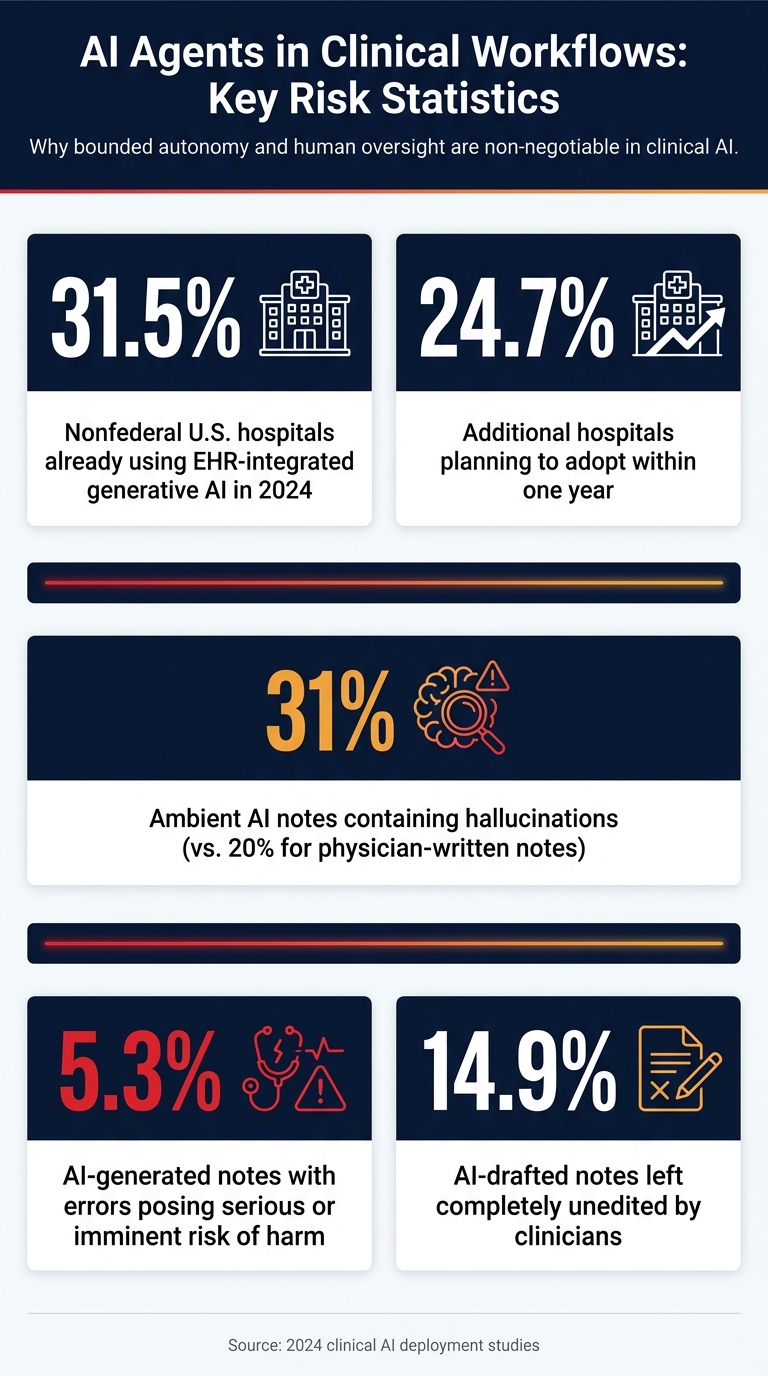
AI Agents in Clinical Workflows: Key Risk Statistics
Where AI agents create exposure in clinical workflows
Triage and patient routing
Triage is one of the highest-stakes places to use an AI agent. If the system undertriages a patient, someone who needs urgent care may get sent to routine follow-up instead. If it overtriages, high-acuity pathways can get swamped with patients who don't need that level of response.
The bigger danger is undertriage because it delays urgent treatment.
Bias can make both problems worse. When a triage model is trained on skewed data, it may systematically rate illness as less severe in Black patients, older adults, or people with limited English proficiency. Those groups already face a higher risk of delayed care, so the model can deepen an existing gap.
There's also automation bias. A clinician may lean on the agent's recommendation even when it clashes with their own judgment. Without a human override and a clear escalation threshold, a bad recommendation can move through the workflow unchecked.
Documentation, ambient scribing, and record creation
Ambient scribing tools record full visits and turn them into draft notes. That usually means audio, transcripts, and metadata are all part of the workflow.
Those records can include PHI. If vendor storage, prompt handling, or reuse settings aren't tightly controlled, that PHI can leak in ways that are hard to spot at first.
Accuracy is another major problem. A blinded study using the PDQI-9 framework found hallucinations in 31% of ambient AI notes, compared with 20% of physician-written notes.[2] In plain English, the AI notes were more likely to include made-up details, such as exam findings that never happened or symptoms the patient never mentioned.
Omissions can be just as dangerous. A missed allergy, a skipped medication dose change, or a dropped red-flag symptom can lead straight to an adverse drug event or a bad clinical call.
Speaker-labeling mistakes add yet another risk. If the system assigns the clinician's words to the wrong person, it can distort the legal record of symptom reports or consent discussions.
That creates billing and compliance exposure too. If exam elements are misstated or medical decision-making complexity is recorded inaccurately, the result can be payer denials, audit findings, or even fraud investigations, even when no one meant to document anything incorrectly.
Care coordination, messaging, and decision support
Care coordination agents create a different kind of exposure because they operate across longer care cycles. The danger here is often slow, quiet, and easy to miss.
An agent might mark a referral as complete without confirmation, close a care gap that was never addressed, or send a follow-up message to the wrong patient. None of those errors has to trigger an alert. On paper, the dashboard may look fine while patients quietly fall through the cracks.
Access drift is a specific concern. As integrations grow and staff roles shift, an agent's access can expand beyond what was first approved. It may end up reaching more EHR data or taking actions it was never meant to take.
Outdated context makes this worse. Old problem lists, missing lab data, and model drift can chip away at recommendation quality over time. In some cases, that drop shows up first in certain patient groups before the top-line metrics change at all.
These weak points map directly to the controls organizations need around access, review, and logging.
sbb-itb-535baee
AI Agents You Can Actually Trust in Healthcare: From Opaque to Governed Automation
Common failure points and the controls that reduce them
These workflows create exposure when controls are weak. The table below maps the most common failure points in clinical agent deployments to the controls that help reduce them.
| Risk Category | Failure Point | Control |
|---|---|---|
| Triage & routing | Final triage level requires clinician sign-off | Bias audits; clinician approval before acuity is set |
| Documentation | Hallucinated content inserted into notes | Clinician attestation before filing; provenance-preserving EHR/FHIR writeback |
| Care coordination | Overly broad permissions enabling unintended actions | Draft first, then clinician review; scoped permissions by role |
| Messaging | Urgent messages misrouted as routine | Escalation rules for safety-critical keywords; override logging |
| All workflows | Weak audit trail | Immutable audit trail for prompts, tool calls, and review |
Access, identity, and tool-use boundaries
Shared service accounts and static API keys are an avoidable access failure. If an agent writes to an EHR under a generic "system" user, no one can clearly trace which clinician started the action, which agent instance carried it out, or what data it touched. That creates trouble for HIPAA access control, audit controls, integrity, and user and system authentication requirements.[4][5]
For triage, documentation, and messaging agents, use one named identity per workflow. A triage agent may read triage queues and prior records, but it should not place orders. A documentation agent may draft notes, but it should not file them without clinician attestation.[3][5][7]
Integrations should run through task queues, draft objects, or FHIR APIs instead of direct write access to production systems. For high-impact actions like medication changes or diagnosis updates, an explicit human approval gate is not optional.[3][7]
Auditability and human oversight for high-impact actions
Output logs alone aren't enough. What's often missing is the full chain: the prompts, the EHR sections queried, the intermediate tool calls, and whether a clinician reviewed the result before it was applied.[5][6][8] Without that record, an organization can't retrace why an agent made a certain recommendation, show that oversight happened, or spot repeat errors before they hurt patients. That's a patient safety problem and an accountability problem at the same time.
In a pragmatic clinical study, 5.3% of AI-generated notes contained errors rated as posing serious or imminent risk of harm if left uncorrected, and 14.9% of AI-drafted notes were left completely unedited by clinicians.[9][10] That's the kind of gap that gets people into trouble fast. High-stakes errors plus low review rates is exactly why a structured oversight framework matters.
Human review should be required for:
- Patient-facing messages
- Chart updates, including allergies, medications, and problem lists
- Any triage or care decision with direct clinical consequences[5][6][7]
Those same logs also support the vendor and governance checks that come next.
third-party and fourth-party dependency risk
An AI agent rarely works by itself. Hosted models, audio services, schedulers, and external APIs can all affect notes, routing, or messages. Each dependency adds another place where things can go wrong.
Inventory those dependencies before deployment. If you skip that step, blind spots pile up fast. Those dependency gaps lead straight into the governance questions in the next section.
Governance and vendor due diligence before deployment
Before go-live, third-party risk needs to be closed out with clear ownership, tight access limits, and vendor terms that leave little room for guesswork. Once outside tools and integrations are on the table, governance has to answer a few basic questions: Who owns the agent? What data and systems can it touch? And when does it need to stop?
Minimum governance controls for clinical AI agent use
Every clinical AI agent needs a defined use case, a named clinical owner, and written action boundaries. That owner should be responsible for scope, performance, incident review, and major changes.[11] This role shouldn't live in someone's head or in a loose email thread. It needs to be written into governance charters and role descriptions.
Each agent should also be limited to the minimum PHI needed under HIPAA. For example, a triage-routing agent may need symptom descriptions and an age bracket, but not full medication lists or billing data. Its use should stay within approved settings, patient groups, and time windows.[11][12][14]
Rollback and incident procedures need testing before go-live. In plain terms, there should be:
- A working stop mechanism at the integration layer
- A documented path back to pre-AI workflows so care keeps moving
- Clear roles for who does what when an AI-related incident is declared[11][14]
Organizations should also keep a central AI registry. This registry should track each agent's purpose, integrated systems, PHI access level, validation status, go-live date, and change-management records for updates. It should serve as the main record for audits and incident response.[11]
Vendor questions that reveal real AI risk
A signed Business Associate Agreement is just the starting point. BAAs need AI-specific terms that spell out whether PHI is used for model training or product improvement, how long data is kept, which subprocessors can access it, and how the vendor will notify you before model or version changes.[11][12][14] If those terms aren't in writing, you're taking on risk without a clear view of it.
Contract language also needs to line up with day-to-day controls. That's where vendor review gets real. The questions below help show whether an agent can operate safely in high-stakes clinical workflows such as triage, documentation, and messaging.
| Vendor Question | Why It Matters |
|---|---|
| Do you process PHI, and will your BAA cover all subprocessors? | Establishes legal accountability for every data flow, not just the primary integration.[11][12] |
| Is PHI used for training, fine-tuning, or analytics, and can we opt out? | Prevents unauthorized secondary use of patient data under HIPAA.[11][14] |
| What is your default log retention period, and can it be configured to our policy? | Retention affects incident response, compliance, and audit availability; some checklists require at least six years to align with HIPAA administrative documentation requirements.[13][15] |
| Can audit logs be exported to our SIEM in near real time, and are they immutable? | Supports adverse event investigation, OCR audits, and liability proceedings.[11][13][15] |
| Provide a complete list of subprocessors and their data access. How are they monitored? | Brings vendor-of-vendor risk into view, instead of leaving it buried in the background.[11][13][14] |
| How do you notify customers before model updates or version changes? | Unannounced model changes can alter behavior, undermine validated performance, or introduce new biases.[16] |
| What safety testing and validation documentation can you share? | Helps separate actual risk management from marketing claims. |
Once contracts are signed, monitoring can't stop. Production checks should confirm that these controls still work the way they were supposed to on paper.
Monitoring after go-live and the path to safer deployment
Once access limits, vendor terms, and human review are set, monitoring becomes the next layer of control. Third-party vendor risk management and pre-deployment checklists matter, but they don't finish the job. After go-live, the risk changes shape. It moves from approval to drift, access creep, and changes in how work gets done.
Teams should watch three areas: system integrity, performance, and clinical impact. A surgical-discharge AI model tracked across 6,800 admissions over 33 months at two hospitals kept an overall AUC of 0.82, but drift dashboards still caught input shifts and data pipeline failures that top-line metrics alone would have missed. [17]
That matters because post-deployment surveillance can't stop at a single performance score. It should also watch for output drift, PHI leakage, access anomalies, and actions that fall outside approved scope. In practice, that means scanning prompts and outputs for patient identifiers that don't need to be there, logging every tool call and data access event, and sending alerts when patterns look off, such as repeated access to records outside the current patient encounter. Input shifts, broken integrations, or PHI exposure can hit triage accuracy, documentation quality, and care coordination reliability in direct ways.
Monitoring should also be separate from the vendor when possible. NHS guidance on ambient scribing says monitoring data should be collected and analyzed independently from the manufacturer, so vendor-reported performance doesn't become the only lens on what's happening in production. [1] Those findings should then move straight into incident review and governance reporting.
Oversight only exists when alerts lead to action. A closed-loop monitoring program sets thresholds before launch, sends alerts to named owners with response deadlines, tracks remediation, and reports findings to governance leadership. Override rates, escalation frequency, error reports, and near-miss reviews should feed a formal corrective action process. Without a clear owner, monitoring is just logging.
| Monitoring focus | What it catches |
|---|---|
| System integrity | Uptime issues, failed integrations, broken EHR links [18] |
| Performance & drift | Output degradation, subgroup performance loss, calibration drift [18] |
| Privacy & PHI exposure | Excess PHI collection, unauthorized disclosure, logging gaps [19][20][21] |
| Access anomalies | Unusual sessions, bulk record access, privilege misuse [19][22] |
Conclusion: Safe deployment depends on bounded autonomy
Post-go-live monitoring is what keeps bounded autonomy from turning into unchecked autonomy. AI agents can help with documentation, triage routing, and care coordination. But each new capability also expands the organization's cybersecurity, privacy, safety, compliance, and third-party risk surface.
Safe deployment needs pre-launch boundaries and continuous monitoring, not one or the other. That means a named owner for every agent, clear human review at high-impact decision points, and audit logs used as day-to-day operating controls rather than one-time acceptance tests. Platforms like Censinet RiskOps™ can help centralize AI risk tracking, send findings to the right governance stakeholders, and keep oversight work in one place. The aim isn't slower adoption. It's bounded autonomy you can trust.
FAQs
What makes an AI agent riskier than passive AI?
AI agents carry more risk because they don’t just suggest information. They can trigger actions, access databases, and execute tasks without continuous human oversight.
That kind of autonomy expands the attack surface. It can also lead to unmonitored data exposure, shadow IT vulnerabilities, and failures in clinical workflows. In some cases, these systems may bypass standard access controls, manipulate PHI, or disrupt operations in ways passive AI simply can’t.
Which clinical workflows need the most human oversight?
Workflows that need the closest human oversight are the ones with high clinical impact. If an AI output can directly shape a care decision or end up in the medical record, a person needs to stay in the loop.
That includes clinical decision support - such as sepsis prediction, radiology imaging, and diagnostic algorithms - along with ambient documentation and admin tasks like triage and care routing. In these cases, mistakes aren't small. They can delay treatment, create charting errors, or send urgent requests to the wrong place.
What should hospitals verify before deploying an AI agent?
Hospitals should check for a strong governance framework, the vendor’s security posture, and a clear inventory of AI systems grouped by risk level, with assigned clinical and technical owners.
They should also confirm due diligence on HIPAA and applicable AI laws, a Business Associate Agreement, and technical reviews that cover adversarial attacks, data poisoning, prompt injection, encryption such as FIPS 140-3, fourth-party risks, local model validation, human oversight, audit logging, and shutdown triggers.
