
A vendor review done once a year is not enough for U.S. healthcare. When vendor failures can expose 242 million records or help drive breach costs near $11 million per incident, I need a way to score vendor security, compare it to a set baseline, and track changes over time.
Here’s the short version: I start with NIST CSF 2.0, HICP, HIPAA, and BAAs, build one vendor inventory, rank vendors by patient-care impact, PHI exposure, integration depth, and outage risk, then score a small set of metrics like MFA coverage, vulnerability fix times, assessment status, incident notice speed, and sub-tier risk. From there, I tie scores to contract terms, review cycles, and clear owners across security, procurement, legal, IT, and clinical teams.
What matters most:
- Benchmarking is not a questionnaire. It measures vendor controls with proof and tracks them over time.
- Healthcare risk is different. A vendor issue can disrupt care, billing, devices, hosting, and claims.
- Frameworks set the baseline.
- NIST CSF 2.0 for control areas and scoring
- HICP for healthcare threat focus
- HIPAA for legal control requirements
- BAAs for contract enforcement
- Tiering drives effort. High-risk vendors get deeper reviews, shorter review cycles, and tighter contract terms.
- Scores need action. Example bands: Green: 80+, Yellow: 60–79, Red: below 60.
- Contracts should spell out next steps. That can include incident notice windows, audit rights, annual assessments, encryption terms, and cure periods.
- Monitoring should not stop after onboarding. Reviews should update after breaches, mergers, cloud moves, outages, or money trouble.
- Start with the vendors most tied to care and PHI. That usually means EHRs, clinical apps, medical devices, and data-hosting vendors.
A few data points stand out. A 2025 healthcare maturity study found only about 52% coverage for supply chain risk management and 53% for asset management. That gap helps explain why vendor benchmarking needs fixed scoring, written evidence rules, and contract follow-through.
If I had to boil the article down to one idea, it’s this: set one scoring model, use proof instead of promises, and connect every low score to a named owner and a contract step.
Mastering Vendor Management | Cybersecurity Vendor Risk Management Training | TPRM
sbb-itb-535baee
Frameworks and Regulatory Baselines for Vendor Cybersecurity Benchmarks
Vendor benchmarks should start with recognized frameworks and regulatory requirements. In healthcare, that baseline usually means NIST CSF 2.0, HICP, HIPAA, and BAAs. That setup matters for a simple reason: healthcare vendors often touch ePHI, clinical workflows, and healthcare supply chain security challenges.
Using NIST CSF 2.0 and HICP to Structure Vendor Benchmarks
NIST CSF 2.0 gives healthcare teams a steady way to measure vendor security across its core functions. Start with Govern and Identify.
Govern covers oversight, risk strategy, roles, and supply chain governance, including GV.SC. Identify supports asset inventory, dependency mapping, and risk assessment. For vendors, that means scoring the controls that protect patient data, clinical systems, and service continuity.
The key is to score based on proof, not promises. Use evidence like:
- Policies
- Logs
- Incident-response records
- Continuous monitoring data
That approach is much stronger than relying on self-attestations.
HICP (Health Industry Cybersecurity Practices), published under HHS 405(d), takes NIST and applies it to healthcare settings. It centers on the threats most likely to hit healthcare vendors, including phishing, ransomware, insecure connected devices, and insider misuse.
For vendors that support clinical, device, or revenue cycle workflows, score controls such as identity and access management, email protection, secure patching, multifactor authentication, segmented environments, tested backups, and staff security awareness training.
Once those controls are set, HIPAA and BAAs are what make them enforceable.
Connecting Benchmarks to HIPAA, BAAs, and HHS Guidance
HIPAA Security Rule risk analysis and risk management requirements make benchmarking a practical way to document ePHI protection [2]. It gives organizations a repeatable, documented method to compare vendors against one standard for administrative, physical, and technical safeguards, then rank remediation work based on actual risk exposure.
Business Associate Agreements (BAAs) are where benchmark standards move from policy into contract terms. A well-drafted BAA can require specific, measurable obligations such as a 72-hour maximum window for incident notification, annual third-party assessments, proof of tested incident response plans, minimum encryption standards, and rights to audit or terminate for non-compliance [2]. BAAs turn benchmark scores into enforceable obligations [2].
How Each Framework Contributes to Vendor Benchmarking
Use these layers together so scoring stays consistent and auditable.
| Framework | Role in Benchmarking | Key Benchmark Dimensions |
|---|---|---|
| NIST CSF 2.0 | Defines control domains, score inputs, and governance structure | Supply chain risk (GV.SC), asset management, incident response, recovery |
| HICP / HHS 405(d) | Sets healthcare-specific control thresholds and evidence requirements | ePHI safeguards, clinical app security, medical device controls, staff awareness |
| HIPAA Security Rule | Establishes legal baseline that benchmark scores must satisfy | Risk analysis, access controls, audit controls, transmission security, contingency planning |
| BAAs | Converts benchmark thresholds into contractual enforcement actions | Incident reporting timelines, evidence of controls, reassessment cadence, audit rights |
| HHS HC3 third-party guidance | Supplier security requirements for procurement integration | Security governance, asset management, incident management, personnel security, information protection, sub-tier partner security [1] |
Don’t map these frameworks in a loose way. Define the evidence required and the score that triggers action.
For example, a benchmark tied to NIST CSF GV.SC should state whether the vendor has a formal third-party risk policy and can produce it on request. A HIPAA-aligned benchmark should also spell out encryption standards in plain terms: AES-256 for ePHI at rest and TLS 1.2 or higher for data in transit [2]. That kind of specificity makes benchmark results usable across security, compliance, and procurement.
How to Build a Healthcare Vendor Cybersecurity Benchmarking Program
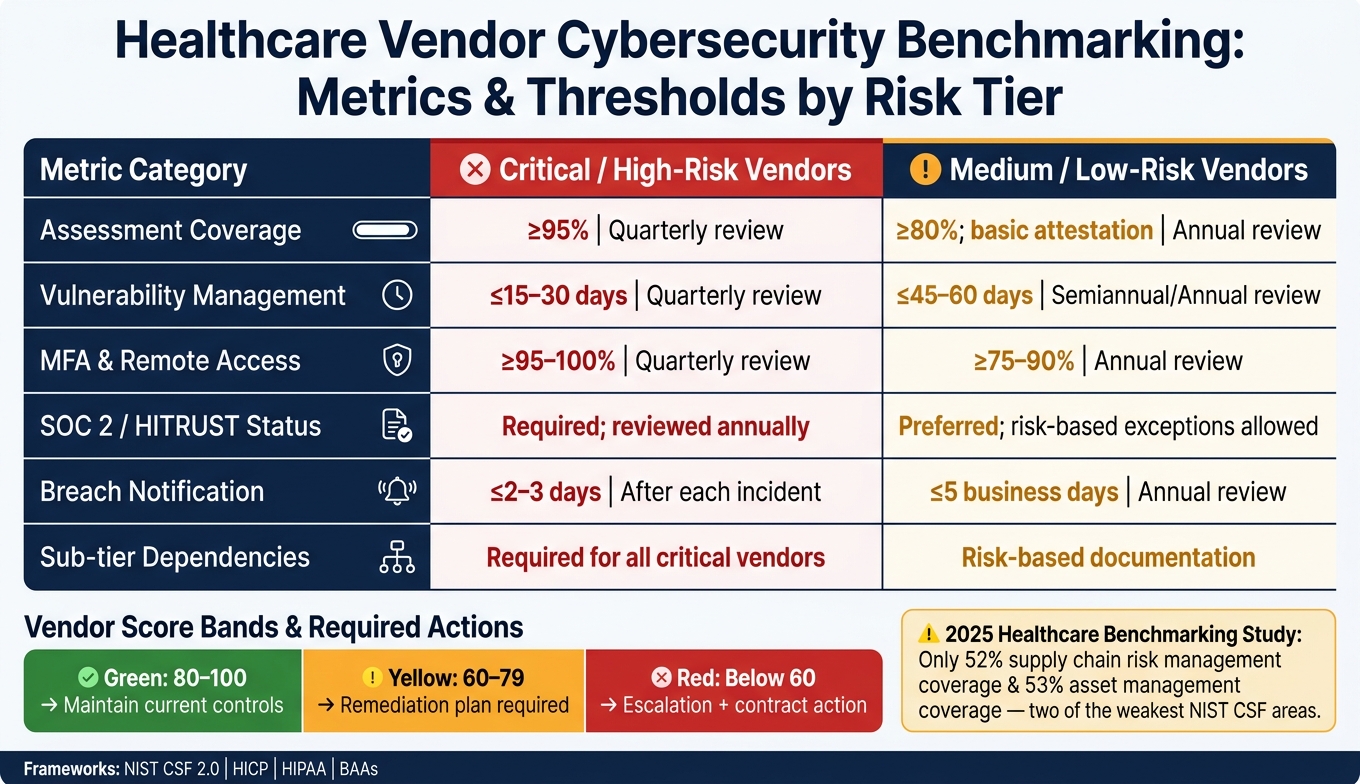
Healthcare Vendor Cybersecurity Benchmarking: Metrics & Thresholds by Risk Tier
Once your framework baselines are in place, the next step is turning them into a program people can actually run. That starts with a clear view of your vendors, the risk each one brings, and a way to measure security that stays consistent over time.
Build a Vendor Inventory and Tier Vendors by Clinical and Data Risk
Start with one centralized vendor inventory. Pull data from procurement, IT, security, clinical engineering, and finance. If you don’t bring those groups together, you’ll miss vendors that came in outside procurement or devices that clinical teams manage on their own.
For each vendor, record the details that shape risk decisions. That includes whether the vendor is a Business Associate under HIPAA, what volume and sensitivity of PHI or PII it handles, how it connects to your systems - such as EHR interfaces, APIs, or VPN connections - whether it’s cloud-hosted or on-premises, its level of network access, the effect on patient care if it fails, and any known sub-tier dependencies.
It also helps to record the current contract term, renewal date, and any past security incidents or breaches. Those details make it easier to decide where follow-up should happen first. Your tiers should then drive assessment depth, review cadence, and contract terms. In plain English: the tier decides which controls, evidence, and review cycle each vendor gets.
Once the inventory is built, tier vendors with a multi-criteria scoring model. Score each vendor on patient-care impact, data exposure, integration depth, and outage risk. A vendor that ranks high for both clinical impact and PHI access belongs in the critical tier and should get the tightest review cadence.
That top tier should face the strictest benchmarks, including:
- Full MFA coverage for privileged and remote admin access
- Quarterly reviews
- Current SOC 2 Type II or HITRUST reports on file
Lower-risk vendors with no PHI access and no dependency in clinical workflows may need only an annual or biennial security attestation.
Tiering keeps reviews tied to patient care and day-to-day impact. That matters. In the first half of 2026, business associates made up 11% of breach reports but were linked to two of the four largest breaches. [3] Those tiers then shape the metrics and thresholds used below.
Choose Measurable Metrics and Scoring Models
Choose a tight set of metrics. In most cases, 10 to 15 is enough. More than that, and teams often end up tracking numbers that look nice in a dashboard but don’t change decisions.
Focus on metrics tied to patient safety and regulatory risk. Track the ones that can trigger remediation or contract action, such as assessment coverage rate, time to remediate high-severity vulnerabilities, MFA coverage across privileged and remote accounts, secure remote access controls, SOC or HITRUST report status, cyber insurance alignment, and breach notification performance. Each score should point to an action: remediation, escalation, or a contract step. Organizations often use on-demand cyber risk management to scale these assessments across their entire inventory.
For scoring, a 0–100 weighted model works well. Give MFA coverage and high-severity vulnerability remediation a weight of 20% to 25% each, since both have a strong link to ransomware and extortion exposure. Set clear score bands:
- Green: 80 or above
- Yellow: 60 to 79
- Red: below 60
Each band should connect to a specific next step, like a remediation plan, a contract condition, or escalation to clinical leadership.
The gap here is hard to ignore. In the 2025 Healthcare Cybersecurity Benchmarking Study, supply chain risk management coverage was 52% and asset management was 53% among participating organizations, making them two of the weakest areas across NIST CSF functions. [4] That’s exactly where a sharp metric set starts to pay off.
Core Vendor Metrics and Example Benchmark Thresholds
The table below shows how metrics, targets, and review cadence can change by vendor risk tier.
| Metric Category | Example KPI | Critical/High-Risk Target | Medium/Low-Risk Target | Review Frequency |
|---|---|---|---|---|
| Assessment Coverage | % of in-scope vendors with completed assessments | ≥95% | ≥80%; basic attestation for low-risk | Quarterly (critical/high); annual (medium/low) |
| Vulnerability Management | Days to remediate critical vulnerabilities | ≤15–30 days | ≤45–60 days | Quarterly (critical/high); semiannual (medium); annual or biennial (low) |
| MFA & Remote Access | % of privileged accounts with MFA | ≥95–100% | ≥75–90% | Quarterly (critical/high); annual (medium/low) |
| SOC 2 Type II or HITRUST status | Current SOC 2 Type II or HITRUST report on file | Required; reviewed annually | Preferred; risk-based exceptions allowed | Annual (all in-scope vendors) |
| Breach Notification | Days from incident discovery to healthcare organization notification | ≤2–3 days | ≤5 business days | After each incident; review annually |
| Sub-tier dependencies | Documented sub-tier dependencies on file | Required for critical vendors | Risk-based documentation | Annual; updated on material vendor changes |
These thresholds are examples, not fixed rules. Adjust them to fit your organization’s size, vendor mix, and lessons from past incidents. But keep the logic the same across tiers so your scoring holds up under review. Those thresholds should then feed governance reviews, continuous monitoring, and contract enforcement.
Running the Program: Governance, Continuous Monitoring, and Contract Enforcement
Once thresholds are in place, governance answers a simple question: who steps in when a score drops? The fix is clear ownership. Each control point needs a named owner, so there’s no guessing when action is due.
Assign Governance Roles Across Security, Procurement, Legal, and Clinical Leadership
No single team can effectively manage third-party risk or vendor benchmarking on its own. Security, Procurement, Legal, IT, and clinical leaders each have a part to play. For vendors in the critical tier, onboarding or renewal should require cross-functional sign-off. And the TPRM committee should have the authority to stop onboarding or renewal if a vendor misses the minimum score and fails to meet the remediation deadline.
This matters even more between formal reviews, when vendor risk can shift fast.
Move from Annual Assessments to Continuous Monitoring
Benchmark scores should work like live signals, not once-a-year snapshots. If a vendor’s situation changes, the score should change too. That means off-cycle reviews should be triggered after breaches, major changes like a cloud migration or acquisition, financial distress, leadership turnover, or outages. Critical vendors should have the shortest formal review cycle. Lower-risk vendors can be reviewed less often, with continuous monitoring in between.
Use the table below to line up each role with its contract authority.
Governance Responsibilities and Contract Controls by Stakeholder Role
Map responsibilities and contract levers by stakeholder.
| Stakeholder Role | Key Benchmarking Responsibilities | Contract Controls Owned or Influenced |
|---|---|---|
| CISO / Security | Framework selection (NIST CSF 2.0), benchmark design, technical evidence review, exception handling | Minimum security control requirements; remediation deadlines |
| Procurement | Vendor inventory management, tiering by operational dependency, TPRM workflow integration | Right-to-audit clauses; termination rights for non-compliance |
| Legal / Compliance | Regulatory alignment (HIPAA, HHS guidance), BAA oversight, exception approval | Breach notification obligations; cyber insurance requirements; liability terms |
| Clinical Leadership | Patient-care impact assessment, clinical workflow risk prioritization | SLAs tied to system availability and clinical safety |
| IT Leadership | Operational metrics tracking, integration standards, technical debt monitoring | Integration standards; technical debt controls |
| CEO / Board | Strategic oversight, exception escalation, remediation funding approval | Board reporting; remediation funding |
Here’s where this gets practical. If contract language directly names benchmark domains like incident response maturity, vulnerability management, and identity and access controls - and also states the minimum acceptable scores - you connect benchmarking results to enforcement right away.
So what happens if a vendor’s score falls below the agreed threshold? The contract already says. It can require a remediation plan with a deadline, a corrective action plan, or escalation to termination. No gray area. No back-and-forth over what comes next.
Using Censinet to Scale Cybersecurity Benchmarking in Healthcare
How Censinet RiskOps Supports Benchmarking and Vendor Assessments
Once you’ve set thresholds and governance, the next step is keeping benchmarking current without piling more work onto your team. That’s where a healthcare-focused platform can help.
Censinet RiskOps™ brings third-party and enterprise risk assessments, cybersecurity benchmarking, and shared workflows into one healthcare-focused platform. It puts vendor tiers in one place and keeps scores linked to clinical impact, data sensitivity, and operational criticality.
RiskOps also maps scores to NIST CSF 2.0 and HICP. On top of that, it tracks unresolved critical findings, remediation time, and trend lines by vendor type.
How Censinet AI and AITM Cut Assessment Time While Keeping Human Oversight
The slowest part of the process is usually intake: questionnaires, evidence, and summaries. Censinet AITM helps move that work along by speeding questionnaire completion, evidence review, and risk summarization while still keeping human approval in the loop.
It can summarize vendor evidence, capture integration details and sub-tier dependencies, and generate risk summary reports from assessment data. In plain terms, it takes a chunk of the manual work off the table.
That said, people still make the final call. Human review controls the final benchmark score.
On the healthcare organization side, Censinet AI pulls key controls and gaps from SOC 2 reports, penetration test results, and policy documents, then maps those findings to benchmark thresholds. That can cut assessment time. But AI-generated summaries or risk ratings don’t affect official scores or dashboards until review and approval steps are complete.
Conclusion: What Healthcare Leaders Should Measure First
With the platform in place, start with the vendors that carry the most risk. That usually means:
- EHRs
- Clinical applications
- Medical devices
- Any vendor that stores or transmits PHI
Then expand from there.
The point isn’t to hit a perfect score on day one. It’s to build a program that gets sharper over time, with clear vendor expectations, continuous measurement, and data that helps shape procurement, clinical, and board-level decisions. Peer benchmarking adds context and shows trend lines over time.
FAQs
How do we start vendor benchmarking with limited resources?
Start by moving away from manual, spreadsheet-based tracking. It often slows teams down, creates bottlenecks, and eats up staff time.
A better path is to use an automated platform like Censinet RiskOps with standardized frameworks such as NIST CSF 2.0 and HPH CPGs. That setup makes assessments easier to run and far less messy.
Automation can take care of repetitive work like questionnaire management and evidence collection. That helps teams scale vendor oversight without adding headcount.
It also keeps data in one place, which makes it easier to spot security gaps, rank remediation work, and back resource decisions with objective data.
What evidence should vendors provide to support their scores?
Vendors should provide current assurance artifacts, such as:
- SOC 2 reports
- HITRUST certifications
- Annual review records
They should also include evidence of incident history, BAA status, and HIPAA compliance over time.
In Censinet RiskOps™, vendors can submit this documentation directly. That makes it easier to keep updates current, speed up assessments, support audit readiness, and check performance against key security benchmarks.
How often should high-risk healthcare vendors be reassessed?
High-risk vendors should go through formal assessments at least once a year. If a vendor handles critical PHI or supports mission-critical systems, it makes sense to review them more often, such as every quarter.
That schedule alone isn't enough, though. Organizations should also use continuous monitoring and run ad hoc assessments after major security incidents or major system changes. That way, risk profiles stay current instead of drifting out of date.
