
AI-based training works better than once-a-year security lessons for healthcare supply chain teams. In the research covered here, phishing click rates dropped from about 20%–33% to under 5% within 12 months, and some programs cut repeat mistakes by 63% when training was tied to the exact error an employee made.
If I boil the article down, the message is simple: train by role, train often, and connect training to live risk signals. That means procurement, finance, and logistics teams should not all get the same lessons. It also means staff need help with newer threats like AI-written phishing emails, deepfake calls, prompt injection, data poisoning, and bad AI outputs in invoice, vendor, and forecasting tools.
Here’s the article in plain English:
- Human error is still a top weak point in healthcare supply chain security.
- Annual awareness training is not enough for fast-changing scams.
- Role-based simulations help teams practice the scams they are most likely to face.
- Short lessons right after mistakes help staff avoid making the same error again.
- UEBA and human risk scoring can show when risky behavior is showing up in live systems.
- AI-specific training is now needed for procurement, finance, and clinical logistics teams using AI tools.
- Risk findings should go to the right owners so training and follow-up do not stop at a report.
Quick Comparison
| Area | Older approach | AI-based approach |
|---|---|---|
| Training timing | Once per year | Frequent short sessions |
| Training content | Same for everyone | Based on role and behavior |
| Phishing practice | Generic tests | Simulations tied to job tasks |
| Response to mistakes | Little or delayed follow-up | Immediate microlearning |
| Risk monitoring | Alerts only | Behavior scoring plus coaching |
| AI risk coverage | Basic or missing | Deepfakes, prompt attacks, poisoned data, bad outputs |
| Supply chain fit | Low | Built around invoices, vendors, contracts, ERP access, and forecasting |
Bottom line: if you work in a healthcare supply chain security challenges, the article argues for a tighter loop between risk assessment, employee behavior, AI-focused training, and follow-up by the people who own the issue.
sbb-itb-535baee
What recent studies say about AI-personalized security training
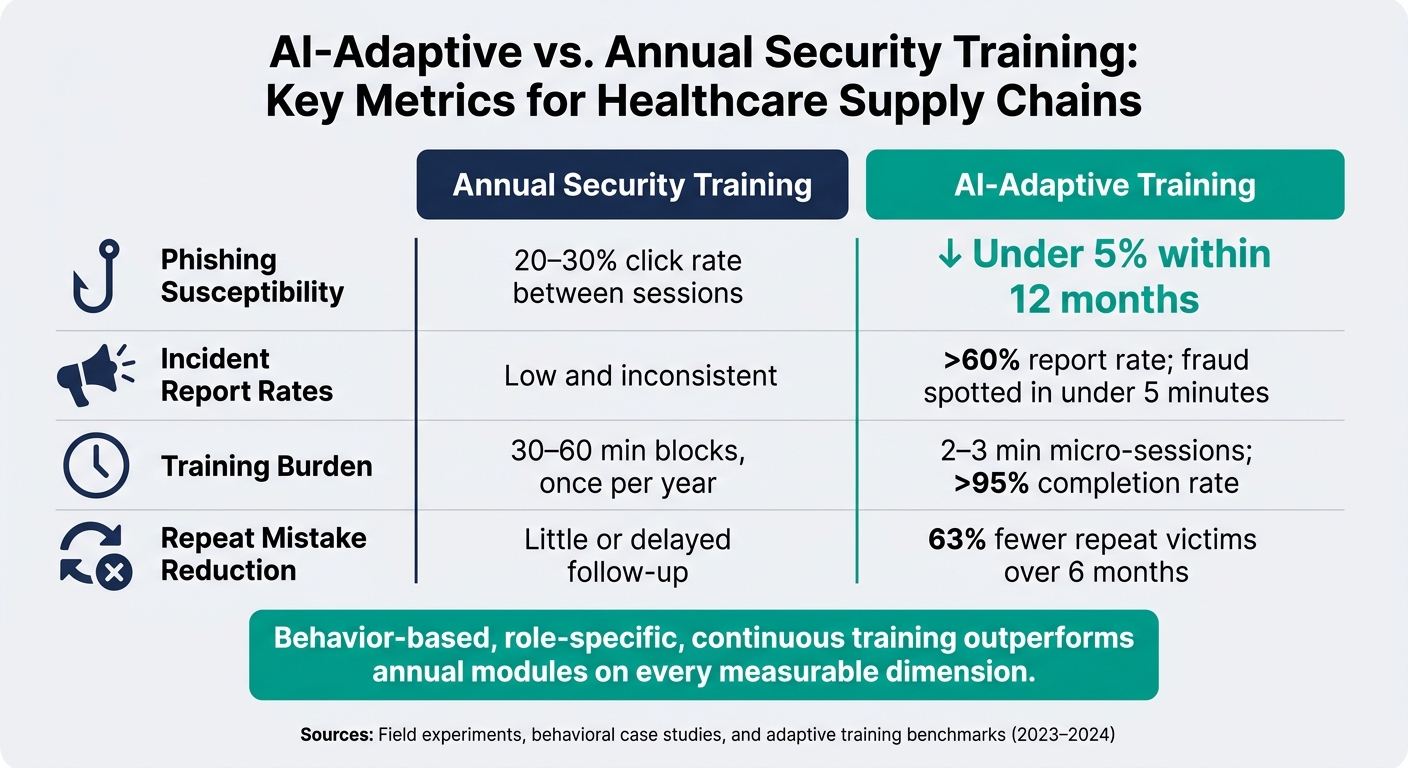
AI-Adaptive vs. Annual Security Training: Key Metrics for Healthcare Supply Chains
Recent studies point in the same direction: behavior-based, role-specific, continuous training beats once-a-year modules on phishing clicks, incident reporting, and how fast people spot social engineering.[3][4][9] Ongoing adaptive programs that combine simulations with contextual microlearning have shown average phishing click-through rates drop from about 20%–33% to under 5% within 12 months.[4][9]
Role-based learning paths and adaptive phishing simulations
This starts to matter in a very practical way when training lines up with the fraud each team is most likely to face. AI-personalized programs assign role-specific threats and simulations across supply chain functions.[4][8]
Procurement teams train on fraudulent bank-detail changes and out-of-band supplier verification.[4][6][8] Finance teams focus on purchase-order spoofing, fake refunds, and BEC disguised as invoice email.[4][6] Supply chain analysts work through fake shipment-update links and credential-harvesting pages.[3][4]
AI-generated simulations make these cases feel much more lifelike. They can use organizational data such as supplier names, invoice formats, and approval chains, then make small changes like swapping routing numbers or adding false urgency. Case studies and benchmarks for healthcare cybersecurity show that contextual phishing simulations lead to more realistic user responses than generic emails, which gives defenders better training data.[3][2][12]
The role-specific setup works best when risky actions trigger feedback right away.
Just-in-time microlearning after risky actions
Timing matters just as much as content. Just-in-time microlearning gives employees a short, focused lesson at or near the moment a risky action happens, like clicking a simulated invoice attachment, sharing contract data through an unsecured channel, or approving a payment change based on email alone.[5][7][10]
Evidence from field experiments and behavior-focused case studies shows that immediate feedback cuts repeat mistakes in a meaningful way. Employees who get feedback right after clicking a simulated phishing link are much less likely to fall for a second attempt than peers who get no feedback.[1][11] Practice-based reports show about 63% fewer repeat victims over six months in some cases when microlearning is tied directly to the error that triggered it and backed up with future targeted simulations.[4][7] In a supply chain setting, that might mean a procurement lead clicks a fake invoice and then gets a two-minute lesson on mismatched domains, unusual urgency, and out-of-band verification.
That same idea also changes how often training should show up.
Annual training vs. AI-adaptive training: a side-by-side look
The gap between the two approaches shows up across several key measures:
| Metric | Annual Awareness Training | AI-Adaptive Continuous Training |
|---|---|---|
| Phishing susceptibility | Often stays in the 20–30% click rate range between sessions[1][10] | Drops to about 4–5% over 12 months with continuous, behaviorally tuned simulations[4][9] |
| Report rates | Low and inconsistent across the organization | Exceeds 60% in some benchmarks; faster time-to-first-report (under 5 minutes)[4][6][11] |
| Time to spot fraud | Days or weeks; relies on general knowledge retained from annual sessions | Minutes or hours; role-specific scenarios build faster, more consistent recognition[8] |
| Training burden | 30–60 minute blocks once per year; disruptive and often misaligned with daily tasks | 2–3 minute micro-sessions integrated into work; completion rates often above 95%[4][5][6][9] |
These gains matter most when they connect to broader monitoring and coaching. A 2023 university review found limited evidence that old-style phishing awareness programs create lasting behavior change, and it noted that some may even increase susceptibility over time.[13] For U.S. healthcare supply chain teams, annual training is still the baseline. But quarterly microlearning, monthly simulations, and event-driven coaching are now doing most of the work.[14][15]
The next step is spotting elevated human risk in live workflows before small mistakes turn into incidents.
Behavioral analytics and human risk management in supply chain workflows
Preventing supply chain incidents takes more than training alone. Training helps shape behavior. UEBA shows whether that behavior sticks in live workflows. That makes behavioral monitoring the layer that comes right after role-based training.
Using UEBA to spot elevated human risk
User and Entity Behavior Analytics (UEBA) builds baselines for users, roles, devices, and applications, then flags deviations that may point to insider risk or account compromise.[17][19][21] In healthcare supply chains, that can include unusual login times, bulk contract downloads, access outside a user's normal vendor set, and repeated ERP failures.[17][19][21]
UEBA works best when it pieces together weak signals. One unusual download might mean nothing by itself. But pair it with a new login location, an off-shift timestamp, and access to an unfamiliar vendor, and the platform can roll those signals into a 0–100 risk score that helps teams decide what to review first.[18][19][25]
There’s one catch: UEBA needs time to learn what “normal” looks like. Most tools need about 60 to 90 days to build reliable baselines. They also work better when activity data includes HR details like department, role, and shift schedule.[25][17]
The next step is what teams do with those signals. Alerts alone don’t fix behavior.
From detection to coaching and policy reinforcement
Detection by itself does not change behavior. The shift that matters is moving from passive monitoring to targeted coaching based on behavioral data.
A controlled study involving 300 employees across finance, healthcare, and education found that behavior-driven training improved phishing detection by 48% and cut policy violations by 36% in three months.[16] That kind of result comes from tying signals to action. Medium-risk scores can trigger short in-workflow coaching. High-risk scores can send employees to mandatory refreshers and manager review.[18][20]
In a supply chain setting, this can look pretty direct. A procurement coordinator who keeps making invoice-related mistakes might get a short module on secure invoice processing or vendor portal use. Managers can get short behavior summaries and coaching prompts, which helps keep the response constructive instead of punitive.[17][18][20]
Monitoring-only UEBA vs. AI-driven human risk management: a comparison
This difference matters because it shapes how fast an organization can cut insider-related risk in supply chain workflows.
| Dimension | Monitoring-Only UEBA | AI-Driven Human Risk Management |
|---|---|---|
| Primary goal | Detect and alert on anomalies | Detect, score, and cut human risk before it turns into an incident |
| Training integration | Minimal or manual; analysts decide whether to follow up | Automatic: behavioral signals trigger targeted microlearning, refreshers, or coaching[20][24] |
| Response to risky behavior | Alert routed to security team for investigation | Tiered response: low risk gets nudges, high risk gets mandatory training and manager review[18][20] |
| Insider risk reduction | Reactive; catches incidents after patterns emerge | Proactive; steps in when subtle behavioral patterns suggest trouble[20][22] |
| Measured impact | Alerts generated and incidents detected | Drops in repeat risky behavior, policy violations, and human risk scores over time[23][26] |
| Supply chain relevance | Flags unusual vendor portal or ERP access | Connects flagged behavior to role-specific training on secure vendor communications, data exports, and invoice handling[17][20][21] |
Monitoring-only UEBA tells you where risk may be building. AI-driven human risk management goes a step further by turning those signals into training, coaching, and follow-up. Those signals become most useful when they feed advanced third-party risk assessment processes and the follow-up described next.
AI-specific training requirements for healthcare supply chain teams
After behavioral monitoring, training needs to cover the AI tools staff now use in supply chain work - procurement, finance, and clinical logistics. That matters because general security training doesn't cover the day-to-day risks that come with AI.
The Health Sector Coordinating Council (HSCC) Third-Party AI Risk and Supply Chain Transparency Guide is clear on this point: supply chain teams need AI-specific training across the full AI lifecycle, not just broad security awareness.[28][31] The NIST AI Risk Management Framework (AI RMF) says much the same. Staff need training protocols so they understand AI limits, risk, and oversight duties from start to finish.[41][42]
What employees need to know about AI-related risk
Many supply chain workflows now rely on AI through demand forecasting tools, vendor risk scoring platforms, and invoice processing systems. That means training should cover the main trouble spots: hallucinations, prompt injection, data poisoning, and deepfake social engineering. It should also use situations employees could run into on a normal workday, such as vendor emails telling staff to bypass approval rules, RFP attachments with hidden text, automated security questionnaire responses that bypass human review, or corrupted supplier feeds that distort risk scores and reorder suggestions.[28][29][30][33][38][40] Staff also need to learn how to verify AI-generated emails, calls, and invoices that imitate trusted suppliers.[36][37]
The big rule is simple: treat AI output as a starting point, not the final word. For high-impact choices - vendor selection, pricing, inventory changes, or PHI access - staff should document validation against risk reviews, contract terms, rules, and trusted risk tools. If an output looks odd, or a ranking or score shifts all of a sudden, the right move is to pause and report it, not push through with a workaround.[28][29][34][35]
Role-specific training for procurement, finance, and clinical logistics
These risks don't land the same way across teams, so training needs to match each group's decisions. HSCC guidance and the NIST AI RMF both point to tiered, role-based training: all staff get basic AI literacy, AI users get workflow practice, and managers and risk owners get deeper training on approval gates and incident response.[42][43][39]
Procurement teams should practice checking deepfake vendor requests through out-of-band channels before taking action. Contract approvers should also complete competency checks and tabletop exercises built around AI-related vendor incidents.[28][29][32][34]
Finance teams need to see how AI invoice tools can be fooled by adversarial formatting and how AI-generated BEC attacks can produce convincing messages from executives or vendors. Exercises should walk staff through AI-flagged low-risk invoices that include small but serious changes - like different bank account numbers - so they don't treat an AI approval flag as final. Finance users with elevated access should also know dual-authorization rules and how to log and report overrides of AI fraud alerts.[28][29][33][34][35]
Clinical logistics and materials management teams face a different problem: AI forecasting mistakes that can affect patient care. Training should include cases where AI underestimates demand for critical medical devices after a corrupted data feed, along with exercises where staff flag AI substitution suggestions that don't match the approved formulary. Because these teams often have broad system access, training should also cover how location and device data may expose patient-care pathways under HIPAA and internal privacy rules.[27][28][30][33][34]
Baseline training controls vs. enhanced AI-specific controls: a comparison
The gap between baseline controls and AI-specific controls stands out when you put them next to each other.
| Dimension | Baseline Security Training Controls | Enhanced AI-Specific Controls |
|---|---|---|
| Policy requirements | General security, phishing, HIPAA, acceptable use | Approved tools, prompt rules, AI vendor-risk requirements built into supply chain governance |
| Competency checks | Annual quiz on basic security topics; policy acknowledgment | Role-based AI assessments; scenario evaluations for procurement, finance, and logistics; re-certification after major AI updates |
| Audit trails | Training completion logs; basic module tracking | AI-specific training tied to system access; logs of AI-assisted decisions; documentation of validation steps for key vendor or inventory decisions |
| Monitoring practices | Periodic review of security incidents and phishing test results | Behavioral analytics on high-risk AI use; targeted coaching based on observed behavior |
| Escalation steps | Report incidents to IT or security via help desk | AI-specific playbooks for suspicious outputs, inconsistent risk scores, suspected data poisoning, or AI-enabled fraud; defined channels to cybersecurity, compliance, and AI governance committees |
Putting training and oversight into practice with Censinet
Using assessment insights to shape employee training
Once AI-focused training is in place, the next move is simple: turn assessment results into action. Risk assessments need to drive training, not just sit in a file.
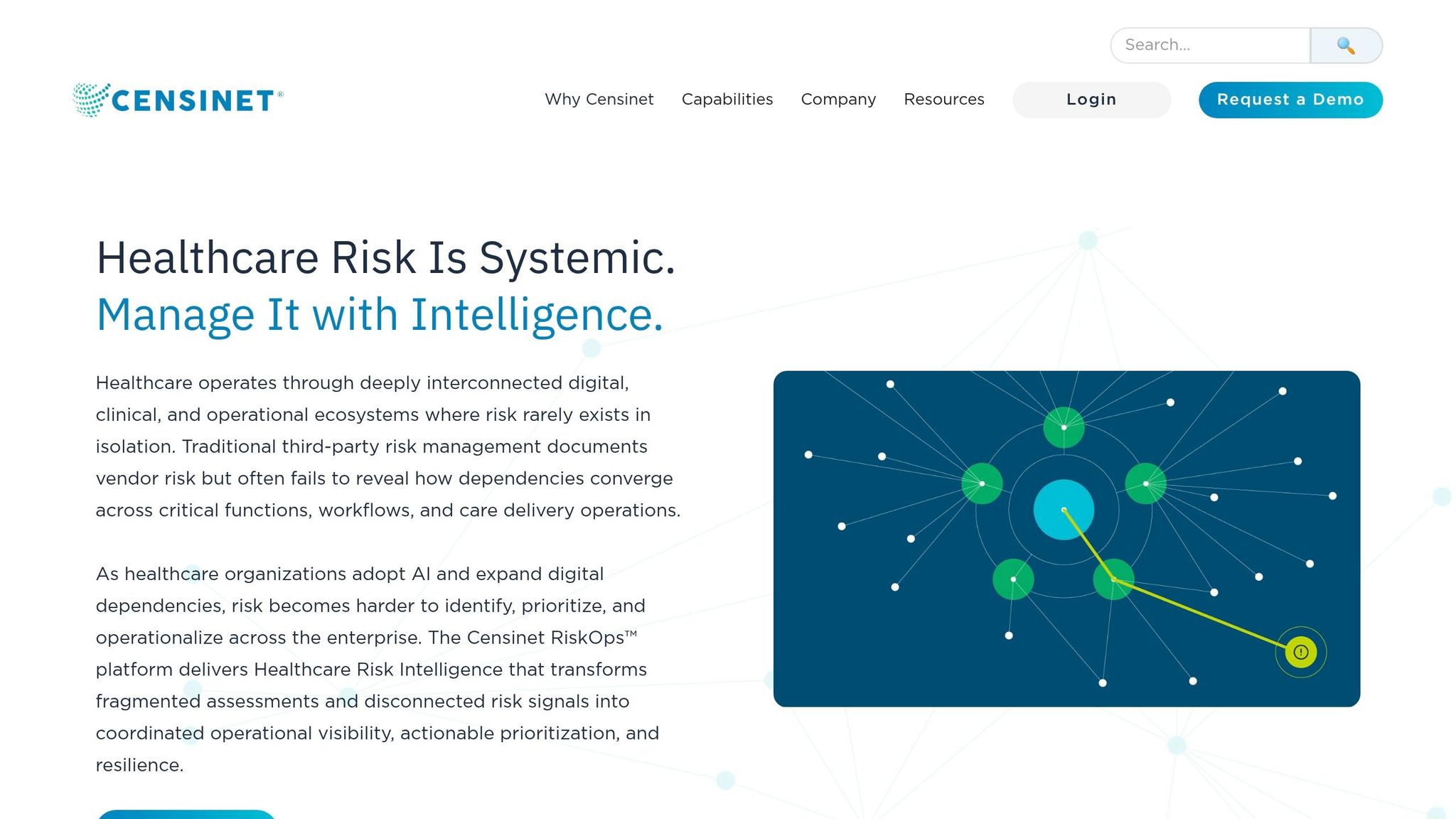
Censinet RiskOps™ produces risk scores, gap analyses, summaries, and heatmaps that give training teams something concrete to use. That makes it much easier to assign the right training to the right people. For example, weak MFA across logistics vendors can lead to training on secure remote access and escalation. Incomplete BAAs can lead to training on compliant vendor documentation.
The same findings can also help set training priorities through benchmarking. By comparing an organization's third-party risk posture with peer HDOs, benchmarking can show where teams are behind. If the data shows an organization lags peers on vendor incident notification clauses, that gap can become a training scenario. Procurement and compliance staff can then work through model contract language and see the real cost of delayed breach notifications.[45][46]
Routing findings to the right stakeholders for follow-up
Once training priorities are clear, each issue needs to reach the person who owns it. That's where many supply chain security efforts fall apart. A risk finding ends up in a report, and no one with the authority to fix it ever sees it.
Censinet AI routes risk findings to the right teams based on risk type, severity, and owner. High-risk vendor findings tied to medical devices or pharmaceuticals go to supply chain leaders and vendor management teams. PHI exposure issues go to GRC and privacy teams. Role-based dashboards help each group stay focused on what applies to them.
This supports the closed-loop governance that NIST SP 800-161 lays out: clear ownership, escalation thresholds tied to risk scores, and proof of remediation before issues are marked resolved.[45][44]
That closed loop is what turns assessment data into day-to-day action.
Conclusion: Key findings for U.S. healthcare leaders
The research points to one clear takeaway: organizations that connect assessment data to role-based training, send findings to accountable stakeholders, and track behavior change over time will be in a stronger position to protect patient data and cut vendor-related incidents across a more complex supply chain.[45][47]
FAQs
How is AI training different from annual security training?
Annual security training usually follows a set, manual format. Teams go through structured modules and take assessments once a year, or when rules change.
AI training works differently. It’s continuous and tied to each person’s role. It helps teams use AI-powered tools in clinical and operational workflows, make sense of real-time insights, and deal with new risks like data poisoning and algorithmic drift through continuous monitoring and stronger governance.
Which supply chain teams need role-based AI security training most?
In healthcare supply chains, role-based AI security training matters most for teams that work directly with PHI, clinical systems, and connected medical devices.
That usually means a few key groups. Security teams need it for incident response, log monitoring, and vulnerability management. Clinical staff need it to use devices and workstations safely in day-to-day care. Billing teams need it to support data minimization and handle secure interactions. And cross-functional AI governance committees need it to review AI use cases and help spot incidents early.
How do UEBA and risk scoring improve employee coaching?
UEBA and automated risk scoring make employee coaching more focused and tied to data. Instead of rolling out broad training for everyone, teams can spot where PHI handling, incident patterns, and control performance show clear security gaps.
With continuous monitoring, organizations can give personalized coaching to employees who use higher-risk vendors or clinical systems. That way, training speaks to the threats people are most likely to face as those threats change over time.
