
Managing vendor risks in healthcare is complex but essential for protecting patient data and ensuring system security. With third-party breaches surging by over 400% in recent years, healthcare organizations must focus on high-risk vendors to avoid spreading resources too thin. Here's a quick breakdown of how to prioritize vendor risks effectively:
- Create a Vendor Inventory: Document vendor access, data sensitivity (e.g., PHI, PII), and contract terms. Include details on fourth-party vendors.
- Classify by Risk Levels: Group vendors into High, Medium, and Low risk tiers based on data sensitivity, operational impact, and system integration depth.
- Conduct Risk Assessments: Use scoring models (e.g., Likelihood × Impact) to assign measurable risk scores for more objective decisions.
- Set Prioritization Frameworks: Allocate resources based on risk tiers, with high-risk vendors requiring more frequent reviews and stricter controls.
- Monitor and Reassess Regularly: Schedule periodic reviews and respond to trigger events like vendor security breaches or regulatory changes.
- Embed Risk into Contracts: Include risk-based requirements in BAAs and SLAs, ensuring vendors meet security standards and incident response obligations.
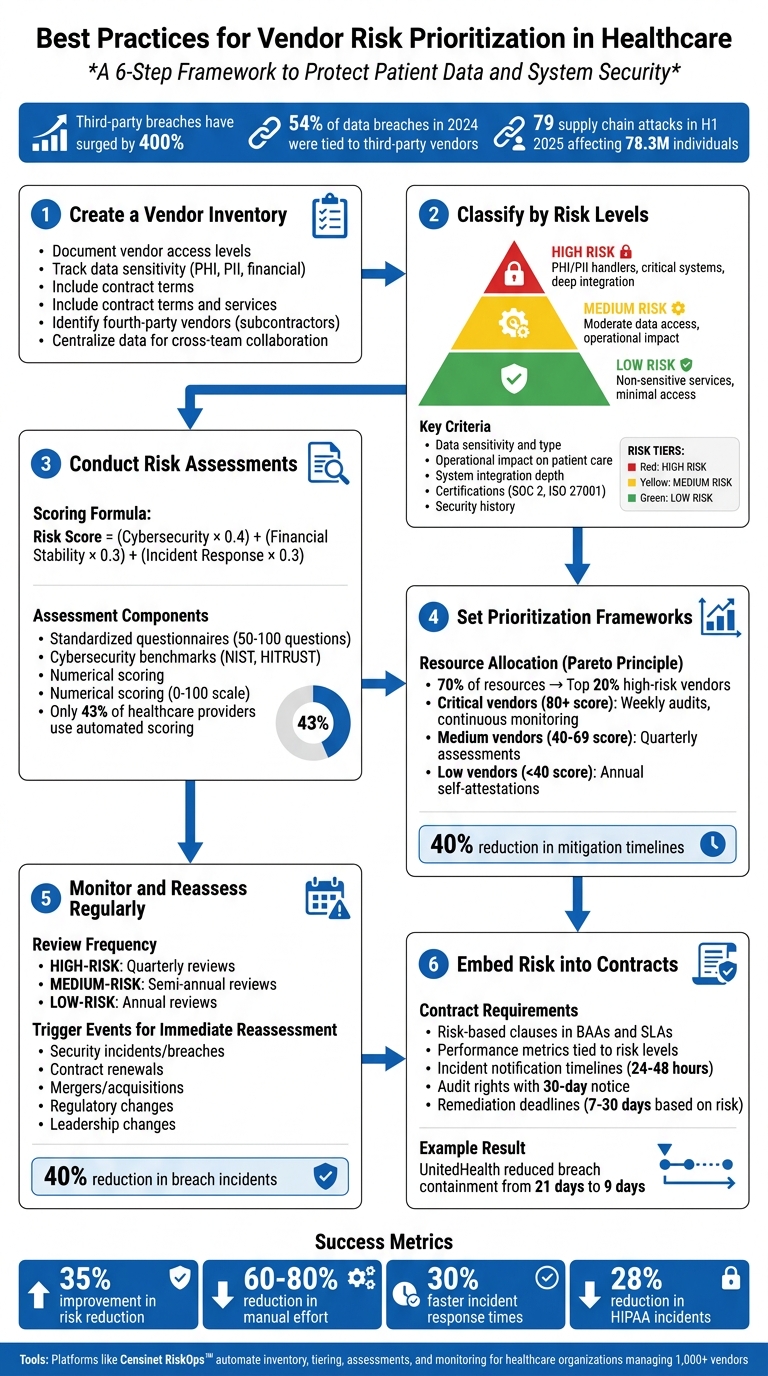
6-Step Vendor Risk Prioritization Framework for Healthcare Organizations
Vendor Management In Healthcare: The High Cost of Failing to Triage Your Vendors
sbb-itb-535baee
Creating a Complete Vendor Inventory
Developing a detailed vendor inventory is crucial for managing risks effectively. Understanding the level of access vendors have is a key part of this process. Your inventory should include specifics like vendor access details, the sensitivity of data they handle, contract terms, and the services they provide.
Make sure to track data sensitivity levels, types of access, contract specifics, and the systems each vendor interacts with. For example, a vendor managing insurance claims presents a higher risk than one providing non-sensitive services. In industries like healthcare, it’s especially important to document whether vendors handle sensitive information like PHI, personally identifiable information (PII), or financial data as part of HIPAA-compliant vendor risk management - and how much of it. This kind of documentation is essential for focusing security efforts, particularly since vendor-related cyberattacks have surged by over 400% in just two years [2].
Centralizing this data allows teams across your organization to collaborate and address risks more efficiently. For instance, if IT identifies a security issue with a vendor, legal and procurement teams should immediately be informed to avoid renewing a contract with unresolved concerns. A centralized vendor risk management tool, such as Censinet RiskOps™, can simplify this process by giving all stakeholders real-time access to updated vendor information. Once the inventory is set up, document each vendor's access methods and the sensitivity of the data they handle to help prioritize risks.
Documenting Vendor Access and Data Sensitivity
Classify vendors based on the sensitivity of the data they handle and their access levels (e.g., low, moderate, critical). Be sure to record details like authentication methods, remote access setups, and system privileges. Pay special attention to vendors involved in claims processing, patient services, IT networking, and pharmacy benefits management, as these functions often involve highly sensitive information and critical systems [2]. For each vendor, document which applications they can access and any privileged access they’ve been granted. This level of detail is essential for implementing security controls like Multi-Factor Authentication (MFA) and conducting thorough audits.
Don’t forget to establish offboarding protocols. When a vendor relationship ends, deactivate their access, update VPN credentials, and confirm that all data has been securely destroyed to eliminate lingering vulnerabilities [2]. After addressing direct vendor risks, extend your review to include their subcontractors - often referred to as fourth-party vendors.
Identifying Fourth-Party Vendors
Fourth-party vendors introduce additional layers of risk. Even if your primary vendors have strong security measures, their subcontractors might not. For instance, a medical device manufacturer may outsource software updates to a third party, or a billing service might rely on a cloud storage provider that hasn’t been vetted.
To identify these relationships, require vendors to disclose any subcontractors who will have access to your systems or data during onboarding and contract negotiations. Include clauses in contracts that require vendors to notify you before engaging new subcontractors. This transparency allows you to evaluate whether these fourth parties meet your security standards and whether extra controls or audits are needed.
Document these fourth-party relationships in your inventory alongside your primary vendors. Note the type of access they have and the data they interact with. Even if you don’t have a direct contract with these entities, understanding their involvement in your ecosystem helps you identify potential vulnerabilities. By maintaining accurate and detailed records, you can classify risks more precisely and take targeted steps to mitigate them.
Classifying Vendors by Risk Levels
Once you’ve built a complete vendor inventory, the next step is to classify vendors by risk levels. In healthcare, vendors are typically grouped into High, Medium, and Low risk tiers. This approach ensures that your monitoring and risk management efforts are focused on the vendors that pose the greatest potential threats to your operations, patient safety, and compliance requirements. By leveraging this classification, you can direct your resources where they’ll have the most impact.
The importance of this step is clear when you look at the numbers. In 2024, 54% of data breaches were tied to third-party vendors [3]. Just in the first half of 2025, there were 79 supply chain attacks in healthcare, impacting 690 organizations and exposing the data of 78.3 million individuals [3]. These statistics highlight why accurate risk classification is essential. For example, a vendor managing your electronic health records (EHR) system carries far more risk than one supplying office furniture.
Criteria for Risk Tiering
There are several key factors to consider when assigning vendors to risk tiers:
- Data Sensitivity and Type: Vendors handling sensitive information like Protected Health Information (PHI), Personally Identifiable Information (PII), or financial data should be flagged as higher risk. For instance, a billing service managing insurance claims is high risk, while a vendor providing non-sensitive tools for marketing might fall into the low-risk category.
- Operational Impact: Think about how a vendor’s downtime could affect patient care. Vendors that support mission-critical functions - such as EHR systems, scheduling platforms, or pharmacy benefits - are inherently higher risk. A good example is the 2024 cyberattack on Change Healthcare, which disrupted electronic prescribing and claims systems, affecting 100 million individuals. The Office of Civil Rights described the incident as having an "unprecedented impact on patient care and privacy" [4].
- System Integration Depth: Vendors with deep integration into your systems or facilities can introduce significant vulnerabilities. This includes those with remote network access, physical access, or administrator-level permissions. Document their level of access - whether they connect to your EHR, use VPNs, or manage privileged accounts - and weigh this heavily in your risk assessment.
- Certifications and Audit History: Vendors with certifications like SOC 2 Type II or ISO 27001, as well as a clean history of regulatory audits, are generally lower risk. However, consider that in 2023, 74% of cybersecurity issues in healthcare were linked to third-party vendors [4].
- Performance and Security History: A vendor’s track record matters. Those with repeated security incidents, compliance failures, or poor incident response protocols should be rated higher risk. Similarly, if a vendor’s failure could lead to major financial loss, legal issues, or operational disruptions, it’s a clear indicator of elevated risk.
To make this process more objective, use a Likelihood × Impact formula. Assign scores (1–5) for each criterion, multiply by its weight, and calculate a final risk level. Tools like Censinet RiskOps™ can automate this process, providing ongoing monitoring and consistent scoring. This structured approach ensures that your risk assessments are both repeatable and data-driven.
How Risk Tiers Affect Resource Allocation
Your risk tiers directly determine how you allocate resources, set review schedules, and prioritize mitigation efforts. High-risk vendors demand the most attention, including continuous monitoring and in-depth reviews. Medium and low-risk vendors, on the other hand, can be managed with less frequent and less intensive assessments.
For high-risk vendors, use comprehensive security frameworks like the Standardized Information Gathering (SIG) questionnaire or HIPAA baselines. Low-risk vendors may only require a healthcare third-party risk assessment questions. This tiered approach ensures your team’s efforts are focused where they’re needed most.
Monitoring frequency should also align with risk levels. High-risk vendors may require continuous oversight, while medium-risk vendors could be reviewed annually, and low-risk vendors every two years. Additionally, establish strict remediation timelines for high-risk vendors to address vulnerabilities quickly.
Don’t forget to revisit your weighting criteria annually. As regulations change and new threats emerge, adjust the importance of specific factors - such as prioritizing data privacy over financial stability - to reflect the current risk landscape. Reassess vendor tiers if their scope of work changes or if a major security incident occurs in their industry.
Finally, account for fourth-party risks. Ask vendors about their subcontractors and supply chain dependencies. Even a vendor with strong security practices can introduce risk if they rely on a subcontractor with weaker protections. By factoring in these upstream risks, you’ll ensure your classifications remain thorough and aligned with actual threats. This structured approach makes it easier to direct your risk mitigation efforts effectively.
Conducting Risk Assessments and Scoring
Once vendors are sorted into risk tiers, the next logical step is conducting structured risk assessments. This process transforms subjective evaluations into measurable risk scores, providing a clear picture of vendor priorities. With 82% of healthcare organizations experiencing third-party data breaches in 2023 [18], these assessments are essential for safeguarding patient data and ensuring uninterrupted operations.
The process typically involves three key tools: standardized questionnaires to gather vendor security information, cybersecurity benchmarks to compare against industry norms, and scoring models to assign numerical rankings. Together, these elements create a repeatable system that reduces manual work and improves accuracy. However, according to the HIMSS 2024 Cybersecurity Survey, only 43% of healthcare providers use automated scoring models, which slows the identification of critical risks [19].
Defining Assessment Criteria
Start by outlining specific criteria that align with healthcare regulations and your organization's risk tolerance. Key areas to evaluate include:
- Cybersecurity posture: Encryption standards, multi-factor authentication, and vulnerability management.
- Financial stability: Credit ratings and debt-to-equity ratios.
- Incident response capabilities: Breach notification timelines and tested recovery plans.
For healthcare organizations, compliance with HIPAA and proper handling of PHI (Protected Health Information) are non-negotiable. To keep the process manageable, experts suggest focusing on 5–10 core criteria, with a weighting system such as 40% for cybersecurity, 20% for financial stability, 20% for incident response, and 20% for compliance history [6].
Use standardized questionnaires like SIG or CAIQ, limiting them to 50–100 targeted questions. For example, you might include:
- 20 questions on security controls
- 15 questions on compliance
- 10 questions on incident response
Make sure to include healthcare-specific topics like PHI encryption, access controls for clinical systems, and risks from subcontractors. Secure portals with clear two-week deadlines help streamline this process. Vendors should also provide supporting evidence, such as SOC 2 reports or results from penetration tests [9].
Platforms like Censinet RiskOps™ simplify workflows by allowing vendors to share pre-completed assessments through a collaborative network. Tower Health’s CISO, Terry Grogan, noted that implementing Censinet RiskOps increased the volume of assessments while reducing required staff from three full-time employees to two [5].
Once your criteria are in place, scoring models integrate these factors into an overall risk score.
Using Scoring Models to Rank Vendors
Scoring models consolidate assessment criteria into a total risk score, often using a 0–100 scale. A common formula might look like this:
Risk Score = (Cybersecurity × 0.4) + (Financial Stability × 0.3) + (Incident Response × 0.3).
This approach enables direct comparisons between vendors. For example, a cloud provider with excellent cybersecurity (90/100) but weak financial health (40/100) would score 72 overall, making it a higher priority than a vendor scoring 55 with lower data sensitivity.
To add objectivity, integrate benchmarks from frameworks like the NIST Cybersecurity Framework or HITRUST. Vendor responses can be mapped to maturity levels: NIST Tier 4 compliance might translate to 90 points, while Tier 2 compliance could score 60 points. Vendors falling more than 20% below peer benchmarks in critical areas like access controls or encryption should be flagged for further review [10].
Censinet’s collaborative risk network, which includes data on over 50,000 vendors and products in healthcare, allows organizations to benchmark vendors against industry peers [5].
Automation is a game-changer for scaling risk assessments. AI-powered tools can auto-fill questionnaires, apply scoring algorithms, and generate real-time dashboards for ranking. Healthcare organizations using these tools report 60–80% reductions in manual effort and quicker identification of high-risk vendors [11]. For instance, a major U.S. health system implemented a weighted scoring model after a ransomware surge in 2023. They identified 15% of vendors as high-risk due to poor incident response (scores below 50). By focusing on these vendors, they achieved a 40% year-over-year drop in breach incidents [12].
To keep your scoring model effective, revalidate scores every quarter or after significant events like mergers or security incidents. As threats and regulations evolve, update your criteria annually to ensure the model remains relevant.
Setting Up Prioritization Frameworks for Mitigation Actions
Turn vendor scores into actionable mitigation plans. A prioritization framework links risk levels and numerical scores to specific workflows - such as audit schedules, remediation deadlines, and resource distribution. With 82% of healthcare leaders identifying third-party risks as their top cybersecurity issue and organizations managing over 1,000 vendors on average, manually prioritizing third-party vendor risks is simply not feasible [15].
Think of this framework as a decision-making matrix. Vendors with critical scores (above 80) undergo weekly audits, contract reviews, and continuous monitoring. Medium-risk vendors get quarterly automated questionnaires and training, while low-risk vendors submit annual self-attestations. This tiered strategy reflects the Pareto principle - dedicating 70% of your resources to the top 20% of high-risk vendors ensures efforts are concentrated where they’re most impactful [20]. By structuring the process this way, risk scoring evolves into a clear, actionable plan that aligns with available resources.
In Q1 2024, Mayo Clinic rolled out a tiered framework using automated scoring to prioritize 500 vendors. The results? High-risk remediation timelines dropped from 90 to 30 days. Critical vendors, representing 15% of the total, were monitored with AI-driven audits via RiskOps™, reducing breach exposure by 45% and cutting HIPAA incidents by 28%. Dr. Jane Ellis, the clinic’s CISO, spearheaded the initiative [13].
Using Automation to Speed Up Prioritization
Automation builds on earlier risk scoring models, delivering real-time prioritization. Organizations using these models report a 40% reduction in mitigation timelines, with high-risk vendors receiving quarterly audits instead of the annual reviews applied to lower-risk groups [16].
Censinet RiskOps™ is one tool making this possible. It automates third-party risk assessments, benchmarks cybersecurity performance against healthcare peers, and prioritizes mitigation actions for healthcare organizations. Integrated with tools like ServiceNow, the platform can automatically trigger remediation tickets when a vendor's score drops by more than 20 points or if a breach occurs [1]. Additionally, Censinet’s collaborative risk network, which includes data on over 50,000 vendors and products, allows organizations to benchmark vendors and share pre-completed assessments, speeding up the entire process [5].
Matching Mitigation Actions to Risk Levels
Once automated prioritization is in place, tailor mitigation actions to the vendor’s risk category. High-risk vendors - those handling PHI or critical clinical systems - should face on-site audits, penetration tests, and contract renegotiations. Medium-risk vendors can be managed with remote assessments and training, while low-risk vendors only need annual attestations. Naturally, audits for high-risk vendors require more substantial investments than those for lower-risk groups [1].
Use score thresholds to guide specific actions. Vendors scoring between 70 and 100 might need vulnerability patches within 14 days or Business Associate Agreement (BAA) updates. Scores between 40 and 69 could trigger quarterly scans or enhanced monitoring. Vendors scoring below 40 may only require formal acceptance with proper documentation. For example, a cloud vendor scoring 85 might need Multi-Factor Authentication (MFA) enforcement and SOC 2 audits to ensure they’re securely managing PHI and medical devices [6].
Cleveland Clinic implemented a scoring-matrix framework to automate mitigation for 1,200 vendors. This approach prevented $5.2 million in potential ransomware losses, improved prioritization speed by 62%, and avoided any vendor-related incidents [14].
To ensure the framework remains effective, monitor key metrics like the mean time to remediate (MTTR) high-risk issues (aiming for under 30 days), the percentage of critical vendors audited annually (targeting over 95%), and overall reductions in risk scores over time [1].
Monitoring and Reassessing Vendor Risks Over Time
Once you've prioritized mitigation efforts, the next step is to ensure your risk assessments stay relevant. Vendor risk profiles can shift due to events like breaches, mergers, or changes in regulations. That’s why continuous monitoring and reassessment are critical. A combination of scheduled reviews and trigger-based evaluations helps allocate resources wisely while addressing the majority of risks proactively[1][9].
Setting Monitoring Schedules
The frequency of vendor assessments should match their risk level to maintain a balance between thoroughness and efficiency. For example:
- High-risk vendors (e.g., those managing PHI or critical clinical systems): Quarterly reviews
- Medium-risk vendors: Semi-annual reviews
- Low-risk vendors: Annual reviews[1]
Other factors, like contract length, past performance, or regulatory changes, may also influence the schedule. For instance, a vendor that recently experienced a security issue might require monthly monitoring until their risk stabilizes[1][6]. Similarly, vendors introducing new HIPAA-regulated services or undergoing leadership changes should trigger more frequent evaluations. Leading organizations aim to keep overdue reviews for high-risk vendors under 5%[7][8].
Tools like Censinet RiskOps™ can simplify this process by automating schedules and sending reminders. Integration with platforms like ServiceNow ensures real-time updates, reducing manual errors and keeping monitoring on track[6].
In addition to routine reviews, immediate reassessments are essential for addressing sudden changes in vendor risk profiles.
Reassessing After Trigger Events
Scheduled assessments provide a solid foundation, but trigger-based reviews allow for quick responses to unexpected changes. Key triggers include:
- Security incidents (e.g., data breaches or ransomware attacks)
- Contract renewals
- Mergers or acquisitions
- Regulatory updates (like new HHS guidelines)
- Significant personnel changes within the vendor organization
- Adverse findings during audits[7]
Using automated alerts within your risk management platform can help flag these events. When a trigger occurs, assemble a cross-functional team within 30 days to update risk scores based on standardized criteria and document any necessary actions[1][8].
Following the 2024 Change Healthcare cyberattack, healthcare delivery organizations conducted widespread vendor reassessments, uncovering previously hidden risks from fourth-party relationships[10].
This dual approach - combining regular reviews with trigger-based assessments - not only optimizes resource use but also ensures that evolving risks are addressed promptly[1][9].
To measure success, track metrics like reassessment completion rates (aim for 100%), trends in risk scores, and the percentage of mitigation actions completed within 90 days. One major U.S. health system, for example, reduced breach incidents by 40% by pairing quarterly audits of high-risk vendors with post-incident reassessments. This highlights the real-world impact of a dynamic monitoring strategy[10].
Adding Risk Prioritization to Contracts and Incident Response Plans
Once you've established risk scores, the next step is to weave them into contracts and response plans. This ensures vendors are held accountable for managing risks appropriately. A risk prioritization framework is only effective if vendors are contractually obligated to follow it. This means embedding risk-based requirements into Business Associate Agreements (BAAs) and Service Level Agreements (SLAs), while also tailoring incident response plans to align with each vendor's risk tier. Without these formal agreements, even the most thorough risk assessments won't lead to meaningful action.
Strengthening BAAs and SLAs
Risk scores from your assessments should directly inform vendor contracts, turning priorities into enforceable obligations. Start by incorporating risk clauses into contracts that reflect your framework. For example, vendors handling sensitive data like PHI or managing critical systems should commit to annual risk assessments, multi-factor authentication, penetration testing, and 24-hour incident notification. Additionally, include provisions for audits with 30 days' notice. A sample clause might look like this: "Vendor agrees to address high-risk items per HDO's risk scoring model within 30 days or face a 5% fee withholding."
SLAs should also define performance metrics based on risk levels. For high-risk vendors, this might mean guaranteeing 99.9% uptime or resolving critical vulnerabilities within 7 days. Medium-risk vendors could be required to conduct quarterly vulnerability scans and fix issues within 30 days. According to a 2024 Ponemon Institute study, organizations using risk-tiered SLAs achieved 28% faster incident resolution times because vendors had clear expectations tied to their risk classification[22].
After a major cyberattack in February 2024, UnitedHealth Group revised BAAs for over 150 vendors to include risk prioritization clauses. These updates mandated 48-hour breach notifications for high-risk vendors and the use of joint incident response playbooks. As a result, average breach containment time dropped from 21 days to just 9 days, with $872 million in penalties enforced for non-compliance[17][19].
By formalizing these measures, you lay the groundwork for more effective incident response.
Coordinating Incident Response with Vendors
Incident response plans must also reflect vendor risk tiers. High-risk vendors should participate in quarterly tabletop exercises and integrate with your SIEM systems, while medium-risk vendors might only need annual drills. Contracts should clearly outline responsibilities, such as vendors managing containment for their systems while your team oversees the broader response. Include a requirement for vendors to provide access to their logs within 2 hours of an incident.
In 2024, a healthcare delivery organization successfully contained a ransomware attack in just 4 hours by leveraging a risk-tiered incident response plan with a high-risk cloud vendor storing PHI. Predefined access protocols reduced downtime by 70% and prevented data loss[21].
This showcases how aligning response plans with risk levels can significantly improve outcomes.
To streamline coordination, platforms like Censinet RiskOps™ can be invaluable. These tools provide shared dashboards and automated alerts, making it easier to manage vendor risks in real time. Contracts should also include triggers for automatic reclassification of vendors based on emerging threats, ensuring your framework remains dynamic and responsive.
Conclusion
Vendor risk prioritization plays a crucial role in safeguarding patient data and maintaining operational stability. This guide outlines a clear approach: start by creating a detailed vendor inventory that captures access levels, data sensitivity, and even fourth-party relationships. This step eliminates blind spots and lays the foundation for effective risk management. From there, classify vendors into risk tiers, enabling you to focus resources on the most critical threats.
Risk assessments and scoring models transform subjective concerns into objective, measurable rankings. This helps pinpoint which vendors require immediate action. By integrating prioritization frameworks with automation, you can cut down on manual effort while ensuring mitigation efforts align with each vendor's risk profile. Healthcare organizations that adopt these structured methods have seen a 35% improvement in risk reduction compared to less organized approaches [1][11].
Once your inventory and classifications are in place, continuous monitoring becomes essential. Quarterly reviews, paired with event-triggered reassessments - like those following breaches or significant contract changes - help prevent risk levels from shifting over time. Automation in monitoring can reduce incident response times by 30%, allowing organizations to address issues before they escalate [1][7].
For a more efficient process, tools like Censinet RiskOps™ can handle the complexity of managing thousands of vendor relationships. This platform offers features tailored for healthcare organizations, including inventory management, automated vendor tiering, ongoing assessments, and real-time monitoring. These tools are particularly designed to support the management of sensitive information, medical devices, and intricate supply chains.
To enhance your vendor risk management, start by auditing your processes, addressing inventory gaps, validating risk tiers, and using automation to improve efficiency. Transitioning from reactive to proactive vendor risk management is a critical step in strengthening healthcare cybersecurity.
FAQs
How do I decide which vendors are truly high risk?
To spot high-risk vendors, start by assessing how much access they have to sensitive data and how crucial they are to your operations. Group them into tiers such as critical, high, medium, and low based on their importance. Dive into their compliance reports, like SOC 2, HITRUST, or results from penetration tests, to gauge their security posture. Implement continuous monitoring tools and risk scoring systems to identify which vendors could pose the biggest threats to patient data and healthcare functions. This approach helps you concentrate your efforts on those with the most significant potential risks.
What should I do when a vendor won’t provide security evidence?
If a vendor declines to share security evidence, ask for specific documents such as their security policies, incident response plans, or compliance certifications (e.g., SOC reports, HITRUST). Should they continue to withhold this information, classify them as a higher-risk vendor. You might also need to restrict or suspend their access until they provide the necessary documentation. Taking these steps helps maintain effective risk management and alignment with third-party security standards.
How can I monitor vendor risk without adding more staff?
You can keep an eye on vendor risk more effectively with automated, real-time monitoring tools. For instance, platforms like Censinet RiskOps™ offer centralized dashboards, automated alerts, and continuous tracking of vendor compliance and cybersecurity risks. These tools simplify the risk management process by automating assessments, flagging issues such as security breaches or expired certifications, and highlighting high-risk vendors. This way, you maintain proactive oversight without needing to expand your team.
