
Healthcare organizations are embracing cloud technology, but it comes with serious HIPAA compliance challenges.
By 2025, 94% of healthcare providers are expected to use cloud services, yet 45% face compliance issues due to misconfigurations that expose sensitive patient data (ePHI). In 2023 alone, 540 healthcare data breaches affected over 112 million individuals, with 82% tied to cloud missteps. Fines for non-compliance can reach $1.9 million annually, underscoring the high stakes.
Here’s what you need to know:
- Key Risks: Public cloud vulnerabilities, data sovereignty issues, and security gaps during rapid scaling.
- Shared Responsibility Model: Cloud providers handle infrastructure security, but healthcare organizations are accountable for configurations, encryption, and access controls.
- Solutions: Enforce Business Associate Agreements (BAAs), apply strong encryption, conduct regular HIPAA risk assessments, and use advanced tools like AI monitoring and automated patching.
- Success Stories: Organizations like Cleveland Clinic and Mayo Clinic have reduced risks and costs by combining these strategies with continuous monitoring and disaster recovery plans.
Understanding and managing these challenges is essential to secure patient data while leveraging cloud technology’s benefits.
Is the Cloud REALLY HIPAA Compliant? - 10 Critical Questions Answered!
sbb-itb-535baee
Main Challenges of Cloud Adoption for HIPAA Compliance
Healthcare organizations transitioning to the cloud face three major hurdles that directly impact HIPAA compliance. These challenges arise from the structure of cloud systems and the complexities of managing sensitive patient data.
ePHI Exposure Risks in Public Cloud Systems
To meet HIPAA requirements, healthcare providers must tackle the risks tied to multitenancy and weaknesses in Identity and Access Management (IAM) within cloud environments. Public clouds rely on shared infrastructure, where multiple organizations use the same physical servers. If virtual isolation fails or employees are granted more access than the "minimum necessary" principle allows, these systems become vulnerable [4] [6].
Centralized health data in cloud systems amplifies these risks. Yazan Al-Issa, a researcher at Yarmouk University, highlights this concern:
"The centralization of data provides attackers with an attractive target to steal data and intercept data in transit and diminishes the control healthcare providers have over sensitive data" [6].
Additionally, data remanence - where fragments of electronic Protected Health Information (ePHI) linger on storage systems after deletion - threatens confidentiality [6]. Unencrypted data transmissions (e.g., without TLS/SSL) are especially susceptible to man-in-the-middle attacks [6]. Alarmingly, about 66% of surveyed health agencies have delayed cloud adoption due to these security concerns [5]. These risks are further magnified by difficulties in managing data governance across regions.
Data Location and Regional Compliance Issues
Cloud providers often store data across various geographic locations, making it harder for healthcare organizations to maintain control. HIPAA requires organizations to know exactly where ePHI resides, but tracking this information becomes challenging when data moves across states or countries [4] [6]. This is especially problematic during audits.
Multi-cloud strategies, where providers use services from platforms like AWS, Azure, and GCP, add another layer of complexity. Each platform has its own security and access controls, which can lead to inconsistencies. Richa Tiwari from TrustCloud explains:
"In a multi-cloud setup, each cloud provider may implement its own set of security and access controls. These inconsistencies can create gaps in how protected health information (PHI) is secured" [4].
As organizations scale their cloud operations, these jurisdictional and security challenges become even harder to manage.
Security Gaps from Rapid Cloud Scaling
Rapid cloud scaling poses a significant challenge to HIPAA’s access control and data integrity safeguards. When organizations quickly deploy new virtual machines, storage systems, or databases, security configurations can be overlooked. These missteps often result in vulnerabilities unique to fast-paced scaling [4].
The situation becomes even more complex when multiple cloud service providers are involved. Each provider has distinct security protocols, making it difficult for healthcare organizations to maintain a consistent security framework [4]. This inconsistency can leave gaps that undermine HIPAA compliance efforts.
The Shared Responsibility Model for HIPAA Compliance
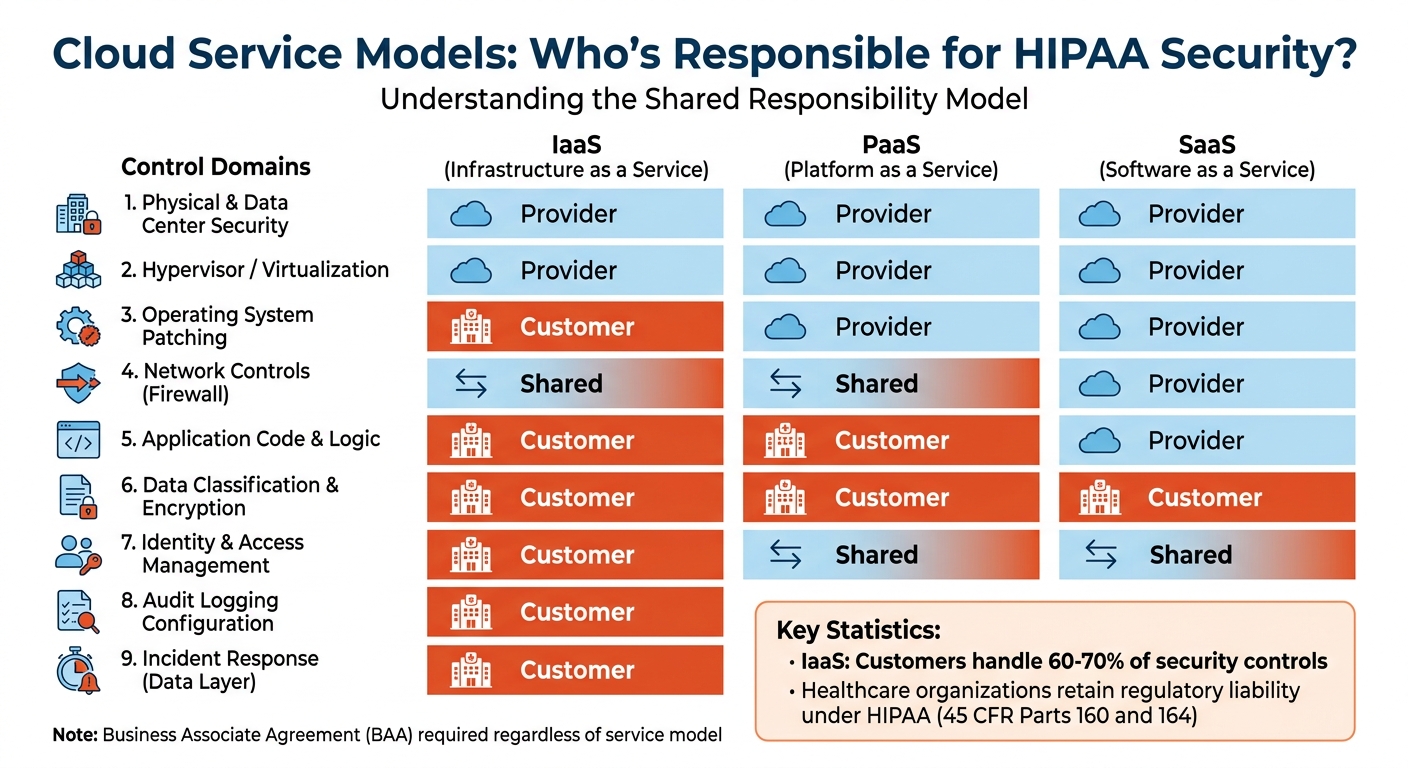
Cloud Service Models: HIPAA Security Responsibilities for IaaS, PaaS, and SaaS
To address the risks discussed earlier, it's crucial to establish a clear division of responsibilities between cloud providers and healthcare organizations.
When healthcare organizations adopt cloud services, security responsibilities are split between the provider and the customer. The shared responsibility model outlines who manages specific layers of the technology stack and ensures security controls are in place at those layers [7]. This distinction is critical because, under HIPAA (45 CFR Parts 160 and 164), healthcare organizations retain regulatory liability, even when third-party providers manage parts of their infrastructure [7].
How Responsibilities Are Divided Between CSPs and Customers
The division of responsibilities hinges on the type of cloud service model in use. For Infrastructure as a Service (IaaS), customers handle roughly 60–70% of the security controls [7]. In this model, the provider manages physical hardware and the hypervisor, while the customer is responsible for everything above that, such as operating systems, middleware, applications, and data.
Platform as a Service (PaaS) shifts more responsibility to the provider, who takes care of the operating system and runtime. However, customers still manage application code and identity configurations. With Software as a Service (SaaS), the provider oversees the full stack up to the application, leaving customers to manage user access, data inputs, and data retention [7].
| Control Domain | IaaS Responsibility | PaaS Responsibility | SaaS Responsibility |
|---|---|---|---|
| Physical & Data Center Security | Provider | Provider | Provider |
| Hypervisor / Virtualization | Provider | Provider | Provider |
| Operating System Patching | Customer | Provider | Provider |
| Network Controls (Firewall) | Shared | Shared | Provider |
| Application Code & Logic | Customer | Customer | Provider |
| Data Classification & Encryption | Customer | Customer | Customer |
| Identity & Access Management | Customer | Customer | Customer |
| Audit Logging Configuration | Customer | Shared | Shared |
| Incident Response (Data Layer) | Customer | Customer | Customer |
Even though cloud providers must sign a Business Associate Agreement (BAA), the ultimate responsibility for HIPAA compliance lies with the healthcare organization. Misconfigurations in customer-managed areas, like cloud storage access controls, are a frequent cause of compliance failures, and under 45 CFR § 164.306, the liability remains with the healthcare organization [7].
This clear division of roles helps healthcare organizations address HIPAA requirements effectively within the shared responsibility framework.
HIPAA Requirements Under Shared Responsibility
Both cloud providers and healthcare organizations must meet specific HIPAA Security Rule requirements, though the implementation varies based on who controls each layer. Healthcare organizations must map provider-managed controls, such as physical security, to HIPAA requirements and determine which controls are "inherited" from the provider's certifications [7]. They are also responsible for documenting controls not covered by the provider, like encryption key management, IAM policies, and audit log reviews [7].
A common challenge arises when providers control infrastructure logs that customers cannot directly access. In these cases, customers must rely on provider transparency and third-party audit artifacts, such as SOC 2 reports [7]. Some responsibilities, like patch management, are shared. For instance, the provider patches the hypervisor, while the customer handles the guest operating system. Similarly, both parties must ensure their respective teams receive security awareness training [7].
To maintain compliance, healthcare organizations should implement continuous monitoring to validate customer-owned controls regularly, not just during audits [7].
Steps to Maintain HIPAA Compliance in Cloud Environments
Managing ePHI in cloud environments comes with its own set of challenges, but healthcare organizations can take specific steps to secure data and meet HIPAA requirements. By aligning efforts with the shared responsibility framework, these measures ensure ePHI is protected in the cloud.
Execute a Business Associate Agreement (BAA) with Cloud Providers
A Business Associate Agreement (BAA) is a mandatory contract under HIPAA whenever a third party handles ePHI for a covered entity. Without a signed BAA, organizations risk facing HIPAA penalties. This agreement outlines how the cloud provider will safeguard ePHI, defines breach notification protocols, and clarifies each party's responsibilities.
While most cloud providers offer standard HIPAA-compliant BAAs, the process involves more than just signing a document. Healthcare organizations must first determine which specific cloud services will handle ePHI and confirm that these services meet HIPAA requirements. The process usually includes reviewing the provider’s template (often available through compliance platforms like AWS Artifact), negotiating custom terms if necessary (e.g., data residency requirements), and finalizing the agreement electronically.
Before signing, organizations should conduct due diligence by reviewing the provider's SOC 2 reports and HITRUST certifications. Legal and compliance teams should ensure the BAA includes key elements such as:
- Permitted uses of ePHI
- Required safeguards like encryption and access controls
- Breach reporting timelines (e.g., within 60 days)
- Procedures for returning or destroying ePHI upon contract termination
- Audit rights for the covered entity
Internal policies should also be updated to reflect these obligations, and staff should be trained to understand their roles in maintaining compliance. According to a 2023 survey, 78% of healthcare leaders consider BAA execution their first step toward cloud compliance [1].
Apply Encryption and Access Controls
Encryption is essential for protecting ePHI, both at rest and in transit. For stored data, organizations should use AES-256 encryption with customer-managed keys provided through managed key services. For data in transit, protocols like TLS 1.2 or higher should be enforced, ensuring secure communications via HTTPS for API calls or VPN/IPsec for private connections.
For example, a healthcare provider using Azure implemented envelope encryption and reduced breach risks by 65% following NIST guidelines [1]. However, encryption alone isn’t enough - access controls must also be in place. Role-based access control (RBAC) and least-privilege policies should be implemented through Identity and Access Management (IAM) systems. Multi-factor authentication (MFA) is another critical safeguard, and solutions like Okta or Azure Active Directory can help secure access.
One U.S. hospital using GCP's BeyondCorp zero-trust model reported preventing 92% of unauthorized access attempts [1]. Additional measures include enforcing conditional access policies based on user location or device status and conducting quarterly access reviews to remove unnecessary permissions.
By combining encryption and access controls, organizations can significantly reduce risks, but ongoing risk assessments are necessary to ensure these measures remain effective.
Perform Regular Risk Assessments
HIPAA mandates annual risk assessments under 45 CFR § 164.308(a)(1), but the fast-changing nature of cloud environments often requires more frequent reviews. Experts recommend conducting quarterly assessments to keep up with evolving cloud configurations and new services.
Effective risk assessments follow established frameworks like NIST SP 800-30 or HITRUST. The process involves identifying all assets that handle ePHI, cataloging potential threats and vulnerabilities (including misconfigurations flagged by Cloud Security Posture Management tools), and prioritizing remediation efforts based on severity. Maintaining a risk register helps track progress over time.
Platforms like Censinet RiskOps™ streamline this process by continuously scanning cloud configurations for HIPAA compliance issues, such as unencrypted storage buckets or overly permissive access settings. Its AI-driven tools prioritize critical vulnerabilities, while collaborative workflows make it easier to share findings with cloud providers. According to user reports, this automation reduces assessment time by 70% [1].
For instance, Cleveland Clinic used Azure alongside Censinet-assisted assessments to identify and address over 150 vulnerabilities each quarter. Similarly, Mayo Clinic, after migrating to AWS under a BAA, implemented encryption and MFA, achieving 99.99% uptime with no major breaches since 2020. These organizations also reported 40–50% cost savings while successfully passing Office for Civil Rights (OCR) audits, as noted in HIMSS 2025 data [1].
Common mistakes include failing to identify which services are covered under the BAA, poor encryption key management, infrequent assessments, and inadequate training on the shared responsibility model.
Advanced Security Methods for Cloud ePHI Protection
Healthcare organizations must employ multiple layers of defense to safeguard ePHI (electronic Protected Health Information) in cloud environments. Basic security measures alone can't address all vulnerabilities, especially as cloud infrastructures grow and adapt quickly. Advanced tools and automated systems are essential for creating a strong and adaptive protection strategy.
Automated Patch Management and Intrusion Detection
Unpatched systems are a major security risk - 60% of HIPAA violations are linked to unpatched vulnerabilities [1]. Manual patching simply can't keep up with the rapid changes in cloud environments. Automated tools like AWS Systems Manager and Azure Update Management help by continuously scanning systems and applying updates during low-traffic periods. Meanwhile, intrusion detection systems (IDS) such as AWS GuardDuty and Google Cloud Chronicle use machine learning to identify threats in real time.
For example, in Q1 2023, Cleveland Clinic employed AWS GuardDuty alongside automated patching to thwart a phishing attack targeting ePHI. The automated system reduced response time from 48 hours to just 2 hours, preventing the exposure of 500,000 records and sidestepping $1.2 million in potential fines [1]. The system flagged suspicious API calls, triggering automated scripts to isolate affected resources, minimizing the need for manual intervention.
These tools often integrate with Security Information and Event Management (SIEM) platforms like Splunk, enabling organizations to respond to incidents in compliance with HIPAA regulations within minutes. Studies reveal that IDS tools have stopped 75% of potential data exfiltration events in healthcare cloud environments [1].
Disaster Recovery and Data Backup Plans
HIPAA regulations under 45 CFR § 164.308(a)(7) require that organizations ensure ePHI availability during outages or disasters. Cloud-based disaster recovery plans (DRP) must meet strict recovery time objectives (RTO <4 hours) and recovery point objectives (RPO <1 hour) [1]. Under the shared responsibility model, healthcare organizations must configure backups correctly while cloud providers secure the infrastructure.
In 2022, a major U.S. hospital system used AWS Backup for geo-redundant ePHI storage, recovering from a DDoS attack without data loss by switching to a secondary region in just 2 hours [1]. They maintained immutable backups - unalterable copies of data - to guard against ransomware. Similarly, a clinic using Google Cloud's Persistent Disk snapshots recovered patient records after flooding, with no compliance violations found during audits [1].
Best practices include quarterly DRP testing with detailed documentation, using tools like Azure Site Recovery for automated failover, and distributing backups across multiple regions. In 2024, Mayo Clinic integrated Azure Sentinel AI with its DRP, cutting recovery time by 65% during a ransomware simulation - from 12 hours to 4.2 hours [1]. With healthcare data breaches costing an average of $10.1 million in 2023, cloud DRPs have helped reduce downtime costs by 50%, according to IBM reports [1].
Using AI for Risk Assessment and Monitoring
AI-driven tools are transforming how healthcare organizations detect and respond to threats against ePHI. Traditional manual risk assessments are slow and often miss new vulnerabilities in dynamic cloud setups. AI automates these processes, reducing assessment time from weeks to hours and identifying 30% more risks than manual reviews [1]. Continuous monitoring provides real-time insights into cloud configurations and access patterns, helping organizations maintain control.
Platforms like Censinet AI™, part of Censinet RiskOps™, analyze third-party cloud providers for HIPAA compliance gaps using machine learning models tailored to healthcare threats. These tools integrate with cloud logs to provide dashboards for collaborative remediation. In September 2022, Intermountain Healthcare adopted Google Cloud's AI Security Operations, automating patching and intrusion detection to block over 15,000 ePHI threats. This approach sped up threat remediation by 78%, with no incidents reported over 18 months [1].
To implement AI tools, organizations can integrate them into existing cloud setups via API connectors for services like AWS S3 buckets. Defining risk thresholds based on NIST frameworks, conducting staff training with simulated breaches, and performing quarterly reviews are critical steps. One U.S. health network's pilot program reduced false positives by 40% and identified a misconfigured PHI bucket in just 15 minutes [1]. By 2024, Mayo Clinic's use of Azure Sentinel AI preemptively flagged 92% of anomalous accesses, achieving a 40% reduction in overall risk [1].
These advanced methods work together to create a comprehensive defense strategy. Automated patching closes vulnerability gaps, intrusion detection identifies threats in real time, disaster recovery ensures data resilience, and AI tools provide constant oversight. For example, Cleveland Clinic's cloud migration case study demonstrated that this approach cut incident response times by 50% [1].
Continuous Monitoring and Auditing for Compliance
HIPAA regulations, specifically 45 CFR § 164.308(a)(1)(ii)(D), require ongoing security assessments to address the ever-changing landscape of cloud-based threats. In 2023, 82% of healthcare breaches involved cloud-stored electronic protected health information (ePHI) [1]. The HITECH Act further stresses the urgency of breach notification, mandating disclosure within 60 days. In 2024, the Department of Health and Human Services (HHS) reported an average penalty of $1.5 million per violation, with over 700 breaches recorded in Q1 alone - 40% tied to cloud storage vulnerabilities [2]. To mitigate these risks, organizations need to move beyond periodic compliance checks and adopt real-time monitoring to identify and address issues before they escalate into reportable incidents.
Real-Time Monitoring and Alert Systems
Real-time monitoring tools are essential for keeping a close watch on cloud environments, detecting unusual access patterns, misconfigurations, and unauthorized activities. Solutions like AWS CloudWatch, Azure Sentinel, and Google Cloud Security Command Center provide HIPAA-compliant dashboards to track critical metrics, such as encryption status, unauthorized access attempts, and API call volumes.
For example, in late 2023, the Mayo Clinic leveraged Microsoft Sentinel SIEM integrated with Azure for real-time monitoring. This setup helped them identify and neutralize a phishing attack within 15 minutes, potentially saving 1.2 million patient records from exposure. The system’s AI-driven anomaly detection ensured 99.9% uptime while monitoring ePHI access logs. Similarly, Advocate Health Care used AWS Config and CloudWatch to oversee over 500 cloud workloads. Their automated encryption checks and access reviews reduced compliance audit findings by 65% and resulted in zero major issues during their 2023 HHS audit.
Key metrics to monitor include failed authentication rates above 1%, which may indicate brute-force attacks, and adherence to data residency policies. A U.S. hospital using Splunk Cloud reduced incident response times by 40% by identifying shadow IT access and implementing just-in-time controls. AI tools like IBM Watson for Cyber Security enhance these systems further, analyzing large volumes of log data with 90% accuracy. According to Gartner, these AI-driven tools can cut compliance costs by 30% in healthcare cloud deployments [3].
However, while technical detection is critical, managing compliance across multiple teams and vendors requires a more collaborative approach.
Collaborative Compliance Management
Ensuring HIPAA compliance when working with multiple cloud providers, internal departments, and third-party partners demands an integrated Governance, Risk, and Compliance (GRC) strategy. Platforms like Censinet RiskOps™ streamline this process by offering real-time compliance dashboards, automated audit workflows, and standardized risk assessments. These tools can reduce assessment times by up to 70% while improving audit trails for HHS inspections.
For instance, a large U.S. health system worked with over 50 cloud vendors using a unified platform to perform risk assessments. This effort uncovered gaps in data localization practices, which could have violated state-specific PHI laws. The collaboration improved their compliance rate by 95%, automated remediation tracking, and helped them avoid a potential $2 million fine. By providing a single source of data, the platform allowed IT, legal, and clinical teams to work together seamlessly, breaking down silos and speeding up issue resolution. Implementation involved signing a Business Associate Agreement (BAA) with the platform provider, integrating cloud APIs for automated data updates, training staff on collaborative workflows, and scheduling quarterly reviews.
Censinet RiskOps™ also enables healthcare organizations to compare their cybersecurity posture with industry peers and manage risks related to cloud providers like AWS, Azure, and Google Cloud. By aggregating data into real-time dashboards, the platform gives a comprehensive view of compliance status. For example, a network of U.S. clinics used it to improve supply chain risk visibility for cloud-hosted medical devices, ensuring all vendors met HIPAA requirements before accessing ePHI systems. This unified approach strengthens the shared responsibility model by clarifying both provider-managed and customer-managed controls.
Conclusion
Moving to cloud infrastructure brings healthcare organizations new possibilities for growth and modernization, but it also comes with complex HIPAA compliance challenges. Addressing these challenges requires more than just technical fixes - it demands a thoughtful, team-oriented approach that unites healthcare providers, internal staff, and external vendors. This collaborative effort lays the groundwork for implementing practical strategies to secure cloud-based systems.
Under the shared responsibility model, cloud service providers handle infrastructure security, but healthcare organizations remain responsible for safeguarding patient data. This includes establishing Business Associate Agreements (BAAs), using encryption, enforcing strict access controls, and conducting effective third-party risk assessments. These measures tackle the core compliance challenges while advanced tools - like automated patch management, AI-powered monitoring, and disaster recovery plans - provide an extra layer of protection when paired with ongoing collaboration.
Innovative solutions are also making compliance more manageable. Platforms like Censinet RiskOps™ integrate risk management and compliance efforts by simplifying third-party risk assessments, offering cybersecurity benchmarks, and providing real-time compliance dashboards. By fostering collaboration across IT, legal, and clinical teams, tools like these transform cloud compliance from a reactive task into a proactive, streamlined process that protects patient data while encouraging innovation.
The stakes are high. According to Health and Human Services (HHS), healthcare entities report over 500 major HIPAA breaches involving electronic protected health information each year, with regulatory fines surpassing $100 million annually. This highlights the critical need for healthcare leaders to adopt thorough cloud compliance strategies. Prioritizing BAAs, encryption, regular audits, and active monitoring ensures patient data remains secure while leveraging the benefits of cloud technology.
FAQs
What cloud settings most often cause HIPAA violations?
Cloud environments often face challenges that can lead to HIPAA violations. Key culprits include misconfigured storage buckets left publicly accessible, overly permissive IAM policies, weak access controls, and unencrypted data. These vulnerabilities can expose sensitive patient information, putting compliance at risk. To mitigate these issues, organizations need to focus on proper configuration, enforce strict access management, and implement encryption to protect protected health information (PHI).
Do I still have HIPAA liability if my cloud provider is “HIPAA compliant”?
Yes, even if your cloud provider claims to be "HIPAA compliant", you are still responsible for meeting HIPAA requirements. Compliance is a shared responsibility. This means healthcare organizations must take active steps, like properly configuring systems, managing data, and implementing strong security measures. Relying solely on the provider’s compliance status won’t guarantee that you meet all HIPAA standards.
How can we prove cloud HIPAA compliance during an OCR audit?
Healthcare organizations preparing for an OCR audit to prove cloud HIPAA compliance need to focus on maintaining detailed documentation. This includes risk assessments, security controls, audit logs, Business Associate Agreements (BAAs), and proof of continuous monitoring. Tools like Censinet RiskOps™ can simplify the process by organizing evidence collection and ensuring that all records are accurate and ready for compliance checks.
